

Condition Monitoring · Engineering example
Predictive HVAC and Refrigeration Maintenance
Know when cooling equipment is changing before a comfort, product, or process problem becomes urgent. Connect temperature, operating mode, energy, alarms, and service findings so technicians can investigate with context.
The operating challenge
A normal setpoint does not prove healthy cooling.
A rooftop unit may satisfy its thermostat while cycling more often, using more energy, or delivering too little ventilation. A cold room may eventually return to setpoint after each defrost but take longer every week. Building and refrigeration teams often see alarms without the outside conditions, door activity, equipment state, and prior service findings needed to judge what changed.
Deterioration is gradual
Capacity, airflow, or heat exchange can change before a high-temperature or comfort alarm appears. The first sign may be longer run periods or slower recovery under comparable load.
One alarm has many explanations
A temperature excursion may reflect a door left open, defrost, a sensor fault, product loading, ambient heat, or equipment trouble. A temperature trace alone is not a diagnosis.
Service history is disconnected
A technician may clean a coil or repair a fan, but the finding and post-work performance never return to the trend. Future dispatches repeat the same investigation.
Why modernize: Give facilities and service teams earlier, more useful evidence, reduce avoidable repeat visits, and preserve the exact reason a condition was escalated. Predictive claims must be earned from reliable history, not inferred from a dashboard label.
Illustrative operating example
A walk-in cooler takes longer to recover.
The equipment and events below are illustrative. They are not a claim about a completed customer installation, a verified refrigerant leak, or a guaranteed prevention of product loss.
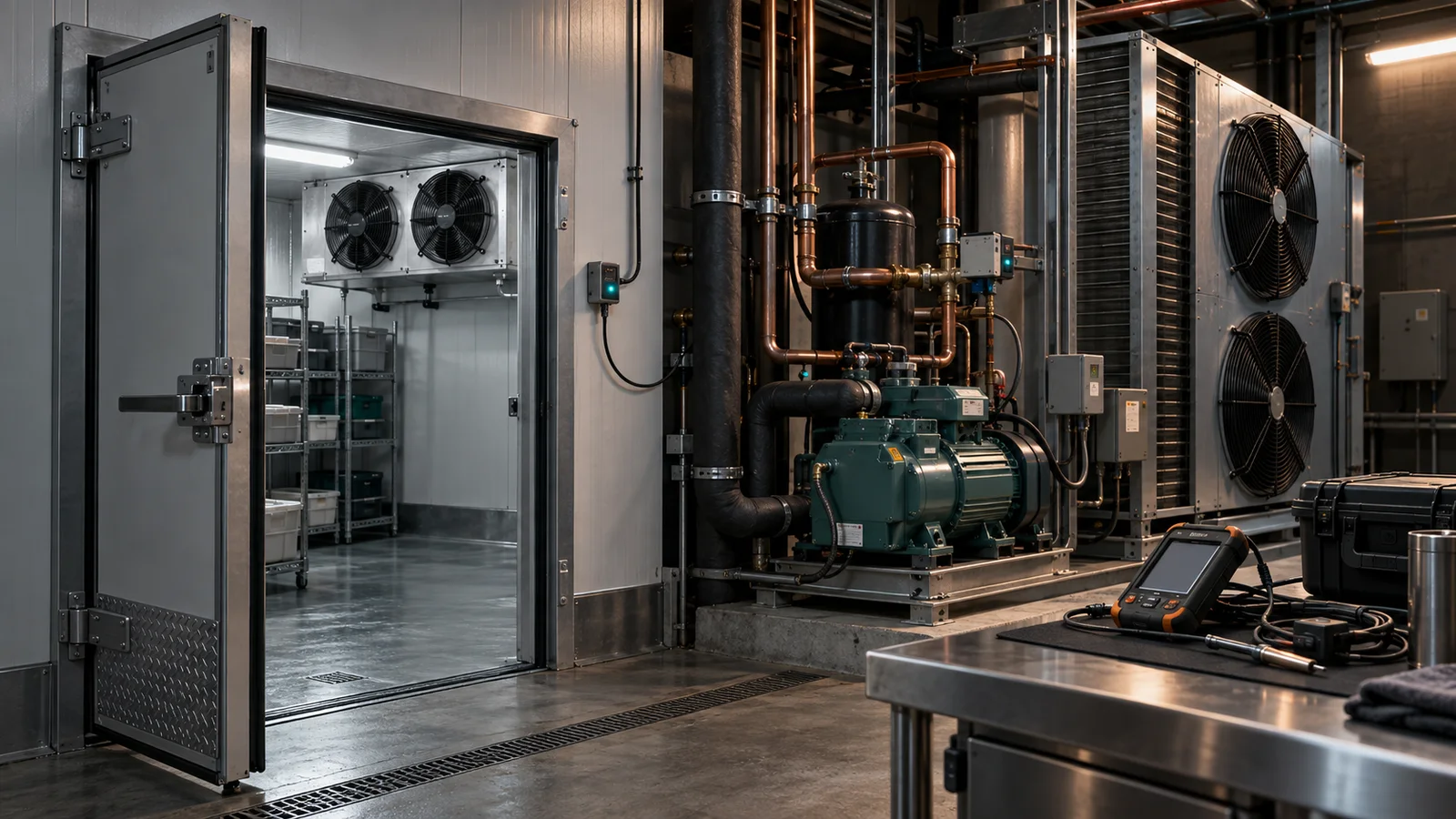
Imagine a walk-in cooler whose room temperature still returns to its approved range. Over several weeks, the recovery after scheduled defrost becomes slower, while compressor runtime rises under similar ambient conditions. A door switch shows frequent openings during some shifts, and a recent service note mentions a fan inspection. Before anyone calls this a compressor problem or a refrigerant leak, the record must distinguish door load, defrost state, fan behavior, sensor placement, and actual equipment response.
- Define the equipment and duty.Identify the room, evaporator, condensing unit, controller, temperature probes, defrost schedule, service history, and the approved operating limits. Confirm which signals are actually available.
- Build comparable recovery windows.Align room and coil temperatures with compressor and fan state, defrost start and end, ambient condition, and door events. Compare like events rather than a busy loading period with an empty room.
- Check the evidence.Flag stale or implausible probes and controller communication gaps. A sensor moved nearer the door may change the trend without any change in cooling capacity.
- Request a qualified review.A sustained increase in recovery time, supported by equipment-state evidence, creates a technician review record. It does not declare a fault mode or command the refrigeration system.
- Close the loop.The technician records the actual finding, action, and post-work recovery under comparable conditions. A door-use explanation, sensor correction, or equipment repair all become useful outcomes.
What the reviewer would see
Cooler C-2: recovery review requested
Existing high-temperature and safety alarms remain in place. The analytical layer has issued no control command.
- Condition
- Longer post-defrost recovery and more compressor runtime during comparable operating windows.
- Context
- Door events, ambient condition, fan state, controller mode, and prior service are visible beside the temperature trace.
- Uncertainty
- Possible load, airflow, instrumentation, control, and refrigeration causes remain open until inspection.
- Action
- Facilities or an authorized service provider reviews priority and follows the existing response process.
Other high-priority situations
The same discipline helps on both sides of the building.
Is a rooftop unit short cycling?
Repeated starts can reflect control settings, sensor location, changing load, or an equipment issue. Compare starts per occupied cooling hour with outdoor temperature, demand, stage, and service history. A fixed rule can flag abnormal cycling for investigation. A technician confirms the cause before changing a control or component.
Useful report: starts, run duration, operating mode, outdoor condition, alarm history, and verified finding.
Is the economizer doing what it should?
An outside-air damper that does not respond as intended can affect energy, comfort, and ventilation. Review damper command and feedback, relevant air temperatures, occupancy schedule, and the approved sequence. An analytical inconsistency is a commissioning question, not permission for software to override ventilation controls.
Useful report: commanded versus observed behavior, applicable conditions, work performed, and retest result.
What a modernization would connect
Keep the controller, context, and service finding together.
A useful first build does not replace the existing controls. It reads available points, proves their identity and timing, and gives a reviewer the equipment state and load context behind a change. Qualified safeties, lockouts, defrost logic, and setpoints stay with the current systems.
Required operating evidence
- Stable asset, room, circuit, sensor, and controller identity
- Room, supply, return, coil, and outdoor temperatures where installed
- Compressor, fan, heat, cooling-stage, and defrost state
- Door activity, occupancy or loading context, and operating schedule when relevant
- Current or metered energy, pressure, or airflow signals only where reliable and available
- Alarm, work-order, refrigerant-service, and post-work records
Missing pressure or refrigerant data must not be fabricated from temperature alone.
Connected technical layers
- Existing BAS or refrigeration controller and independent approved safety devices
- Read-only edge collection with local buffering and point validation
- Historian or time-series store that retains mode and load context
- Facility or CMMS workflow with acknowledgment, finding, and closeout
Network loss makes the analytical view unavailable; it must not disable the controller or obscure a local alarm.
A high room temperature is a condition requiring attention under the facility's existing rules. Analytics can add context, but must never delay or suppress a critical local alarm while waiting for more data.
Where automation and AI fit
Start with explainable faults, then test predictive value.
Deterministic automation
Check point freshness, range, and disagreement; label defrost and maintenance modes; calculate recovery time or cycling only in valid windows; deduplicate repeated review requests. These rules can already make a maintenance handoff more useful.
Analytical models
With trustworthy service outcomes and varied load history, multivariable methods may help detect changing thermal response or abnormal electrical relationships earlier than fixed thresholds. The model must be validated across seasons and equipment modes and compared against simpler rules. It cannot promise a failure date from a small unlabeled sample.
Evidence-linked AI assistance
An approved assistant could summarize the trend, cite service notes and controller events, and prepare questions for a technician. It should identify contradictory or missing evidence. A text summary is not a diagnosis, leak test, food-safety decision, or authority to change equipment settings.
Human and safety authority
Qualified operators and technicians determine inspection, repair, refrigerant handling, critical response, and return to service. Existing high-temperature alarms and equipment safeties remain independent of the new analysis.
How we examine a proposed solution
Relevant AI advisors support design review, not equipment operation.
These are Adaptiv Stratum AI advisory roles for bounded research and analysis. They are not human technicians or a claim that named agents are installed in a client's building. The deployed monitoring design and all permissions would be separately reviewed.
Aegis
Challenges failure-mode assumptions, service evidence, repeat events, and false alarms.
Argus
Reviews point identity, sensor placement, timestamps, and edge continuity.
Helios
Separates energy opportunities from thermal duty and required service levels.
Hephaestus
Checks existing control sequences, safeguards, and the read-only boundary.
Pythia
Tests whether analysis adds useful lead time beyond transparent rules.
Clio and Themis
Challenge evidence quality, test design, authority boundaries, and unsupported claims.
What becomes visible
A good report follows the issue through verified recovery.
The asset view helps a technician understand a current condition. The program view shows whether the monitoring effort improves response, avoids repeat problems, or reveals needless alarms. Both preserve load, mode, and sensor quality so apparent improvements are not misread.
Per-asset service record
- Asset and protected space identity, operating mode, and time window
- Temperature, state, and load evidence with units and source quality
- Defrost, door, occupancy, alarm, and prior work context
- Rule or analytical version and why the review was requested
- Reviewer, technician finding, action, and retest under comparable conditions
Program-level measures
- Valid-data coverage, sensor faults, and communication gaps
- Temperature excursions and recovery time by relevant operating mode
- Runtime and starts per comparable cooling or occupancy period
- Time from valid warning to inspection and verified finding
- Repeat service events, false alarms, and unresolved issues
- Metered energy per comparable load or operating period, where supported
Lower energy is not success if cooling, comfort, or ventilation has degraded. An indirect signal may justify a leak inspection, but only qualified testing and documentation can establish a refrigerant finding.
Operating safeguards
Fail visibly without weakening the cooling system.
Specific safeguards follow the asset, the protected space or product, the local control design, and the agreed scope. Monitoring must not become the only way a critical temperature condition is noticed.
- Probe identity, placement, calibration, and replacement history
- Explicit defrost, door-open, cleaning, loading, and maintenance states
- Freshness, range, cross-sensor, and communication-loss checks
- Immediate local alarm path for critical limits, independent of analytics
- No inferred refrigerant leak or component replacement without inspection
- Qualified technician authority for safety, refrigerant, and control work
- Seasonal and load-aware comparison before predictive claims
- Post-service confirmation and learning from false alarms
A practical first phase
Choose one consequential cooling asset and one review question.
- Define the consequence.Choose a cooler or rooftop unit where earlier context would change a maintenance decision. Identify existing critical alarms and response owners.
- Map available points.Confirm controller data, probe quality, equipment identity, service history, and the differences between scheduled, observed, and inferred state.
- Establish valid windows.Separate defrost, door loading, occupancy, and maintenance from comparable operating periods. Preserve the original controller and safety behavior.
- Run in observation mode.Test transparent recovery or cycling rules, discuss each request with technicians, and log findings, false alarms, and missed conditions.
- Decide what earns expansion.Measure whether the program gave useful lead time and clearer work orders. Consider prediction or wider deployment only with trustworthy outcomes and explicit governance.
Begin with one maintenance decision
Which cooling problem keeps returning?
A useful first conversation can start with one asset, the alarms and measurements already available, and the service finding you wish had been visible sooner.
Evidence and further reading
Separate useful diagnostics from unverified claims.
These primary sources inform the method. The situations above remain illustrative, not Adaptiv Stratum customer case studies.
- U.S. Department of Energy: HVAC Commissioning discusses verifying equipment and control operation, including economizers and schedules.
- U.S. Department of Energy: HVAC and refrigeration fault detection describes the role of diagnostics in ongoing building operation.
- U.S. Department of Energy: AFDD testing frameworks highlights the need to evaluate diagnostic performance.
- U.S. EPA GreenChill: Refrigeration leak prevention and repair addresses leak management and qualified maintenance. The guide does not itself establish regulatory compliance.