

Controlled Industrial Intelligence · Engineering example
Digital Twin & Scenario Intelligence
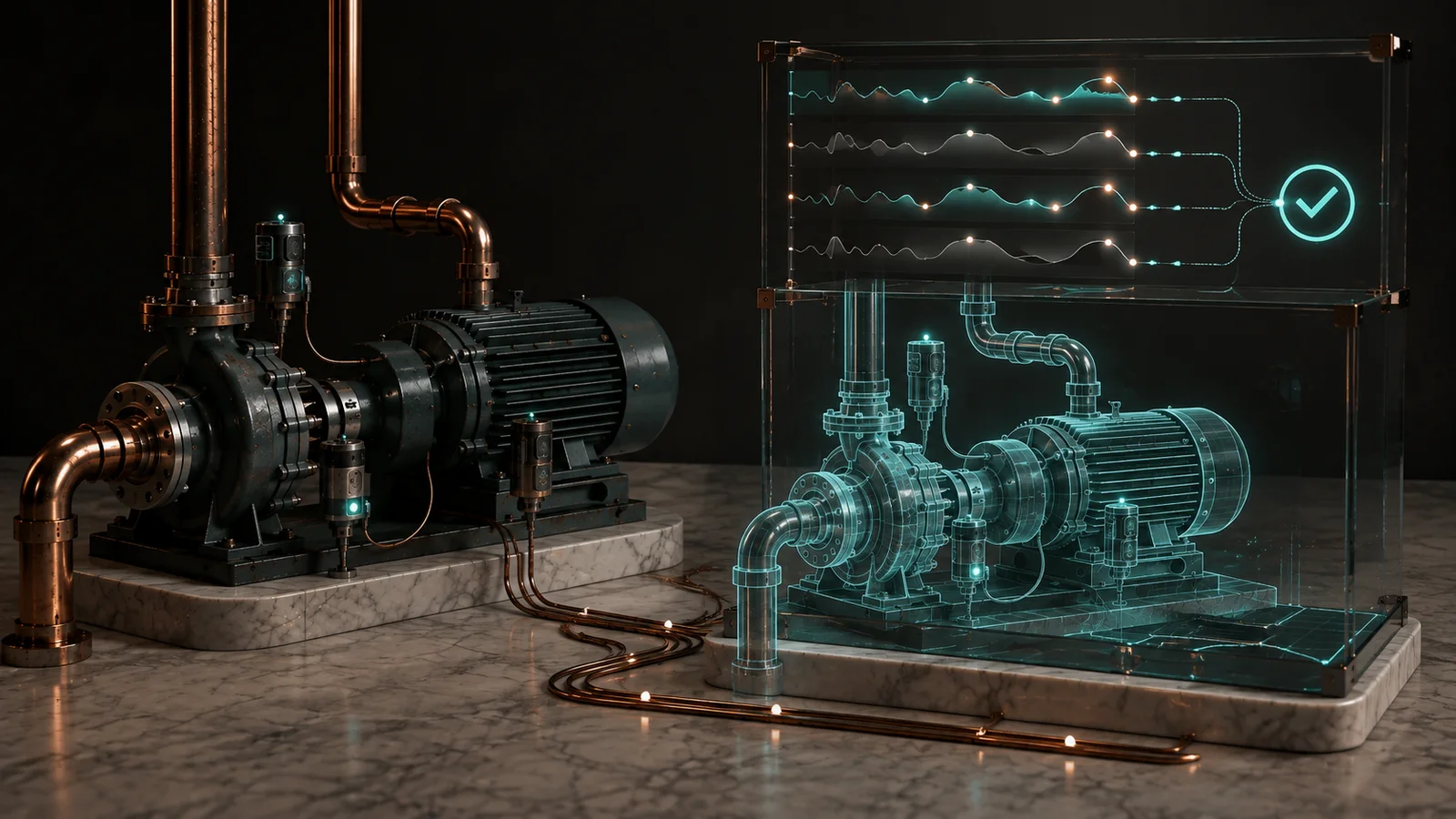
Compare proposed schedules, capacity changes, and maintenance windows against a versioned model of the real operation. Make assumptions and uncertainty visible, then use observed results to decide whether a limited trial is justified.
The operating challenge
A local improvement can create a problem one step downstream.
A faster machine, a different production sequence, or a short maintenance stop can change buffers, staffing, material arrivals, and shipping performance elsewhere. A spreadsheet may show the average capacity of each asset but miss when work queues form or when a shared constraint is occupied. A useful digital twin represents only the relationships needed for a specific decision, compares a proposed change with a credible baseline, and shows where the model has not been validated.
Physical truth first
Identify the actual lines, shared resources, flows, capacities, schedules, and failure modes before simulating them.
Bounded scenarios
Change one documented assumption at a time and keep each result within the model's tested operating range.
Observed outcome
Use a small approved trial to compare the prediction with real measurements and update the model when it is wrong.
Why modernize: Decision makers can see tradeoffs before spending on equipment or disrupting production, while an explicit error range keeps simulation from masquerading as certainty.
Illustrative operating example
Two packaging lines share one inspection station and finished-goods buffer.
This packaging-line scenario is illustrative. It is not a claim about a completed customer installation or a validated model for any specific plant. Real decisions require site data, qualified engineering review, and an authorized change process.
Imagine a manager wants to raise the speed of Line A during a busy week. A simple calculation predicts more cases per hour. In reality, Line A and Line B share an inspection station, operators, pallet movement, and a finite buffer before shipping. Faster output from A may fill that buffer, block B, and leave the dock with less balanced work. A limited twin asks whether the proposed speed change improves completed, accepted shipments rather than merely increasing a machine counter.
- Map the bounded system.Record both lines, the inspection step, buffer capacity, shift pattern, transport delay, and the point where accepted cases leave the system.
- Qualify the baseline.Join timestamped production, inspection, downtime, staffing, and shipment observations for comparable days. Reconcile missing events and clock differences.
- Calibrate and backtest.Run recent historical shifts through the model without changing the process. Compare predicted throughput, queue time, and blocking to actual results, including difficult shifts.
- Compare limited scenarios.Model a modest Line A speed increase, a revised inspection allocation, and a planned Line B maintenance window. Keep demand, staffing, and asset condition explicit.
- Authorize a small trial.Production, quality, and maintenance teams review the tradeoffs, choose a bounded test if justified, and monitor actual performance and stop conditions.
What a reviewer would see
Packaging scenario comparison
Illustrative comparison, not an operating recommendation.
- Baseline
- Observed accepted shipments, queue time, blocking, and model error.
- Change tested
- Line A speed and inspection allocation, with shift and demand assumptions.
- Tradeoff
- Possible throughput gain against buffer saturation and Line B delay.
- Decision gate
- Model validity, uncertainty range, named reviewers, and trial stop rule.
Other high-priority comparisons
Model the decision, not an imaginary perfect replica of the plant.
Maintenance-window planning
Compare a proposed asset outage with current demand, spare capacity, work in progress, and repair duration. Identify where a missed restart would affect downstream commitments.
Useful report: scenario version, assumptions, predicted missed capacity, recovery time, and actual outage result.
Cold-storage capacity
Test a new receiving schedule against dock dwell, room occupancy, temperature recovery, and qualified product-handling constraints. A model outside its validated season or load range should not decide product handling.
Useful report: expected congestion, temperature-risk exposure, uncertainty, and approved trial outcome.
What a modernization would connect
A versioned model is useful only when its state and limits are inspectable.
The twin can be a discrete-event simulation, a physics model, a statistical surrogate, or a hybrid. Its form follows the decision. Start with a system boundary, verified asset and flow identities, qualified historical observations, and a baseline that reproduces important real behavior. Record the data window, calibration, validation error, and assumptions for every scenario.
Required operating evidence
- Asset, flow, buffer, shift, and shared-resource identity
- Qualified event time, status, cycle time, downtime, and capacity
- Demand, material availability, staffing, and quality holds
- Model version, parameters, assumptions, and validity range
- Scenario input, predicted distribution, and sensitivity
- Reviewer, trial authorization, actual result, and model error
Do not fill missing operating states with invented measurements. Label estimates and exclude periods whose data quality cannot be reconciled.
Connected technical layers
- Read-only qualified operating and business data
- Versioned system relationships and constraints
- Calibrated scenario or simulation engine
- Backtest, sensitivity, and uncertainty checks
- Review, limited trial, and outcome feedback
The scenario engine compares possibilities; it is not a controller and does not issue machine commands.
If a scenario changes equipment, staffing, product, or demand beyond the validated range, its output becomes a hypothesis requiring fresh engineering review, not a decision-ready prediction.
Where automation and AI fit
Automate comparison and evidence assembly, not authorization.
Deterministic automation
Join qualified events, calculate baselines, enforce valid scenario ranges, and flag infeasible inputs. Keep source versions and model changes traceable.
Modeling methods
Use simulation for queues and shared resources, physical equations where appropriate, and sensitivity tests to show which uncertain inputs drive an answer.
Evidence-linked AI assistance
Summarize scenario differences, explain assumptions in plain language, and surface missing constraints. AI can help draft a comparison but cannot certify model validity.
Human operating authority
Engineers validate the model; production and quality owners judge tradeoffs; authorized personnel approve and supervise any real-world trial.
How we examine a proposed solution
AI advisors challenge the model from different directions.
These Adaptiv Stratum AI advisory roles support design review and evidence analysis. They do not validate equipment models or direct operations on their own.
Argus
Checks source identity, timestamps, and missing operating states.
Hephaestus
Challenges physical relationships, bottlenecks, and infeasible flow.
Pythia
Tests sensitivity to uncertain demand and downtime.
Aegis
Looks for stale parameters and out-of-range scenarios.
Clio
Measures prediction error and observed trial outcomes.
Themis
Reviews approval, accountability, and change-control boundaries.
What becomes visible
Report both the predicted tradeoff and how often the model was wrong.
A polished simulation screenshot is not enough. The useful record includes the exact model and data window, baseline fit, scenario inputs, uncertainty, the decision made, and the observed result after a controlled test.
Per-scenario record
- Decision question, model boundary, owner, and version
- Qualified input sources and effective time
- Assumptions, validity range, and excluded conditions
- Baseline and candidate outcomes with uncertainty
- Constraint conflicts and sensitivity to key inputs
- Review decision, trial scope, stop conditions, and result
Model and business health
- Backtest error by operating regime
- Observed versus predicted queue, throughput, and delay
- Scenarios rejected as out of range or infeasible
- Planning time and changes avoided or improved
- Time since calibration and material configuration changes
- Unresolved gaps in data or model coverage
A result outside its credibility range should be marked unsuitable for the decision, even when its point estimate looks attractive.
Operating safeguards
Keep the twin advisory, testable, and current.
- One defined decision and bounded system at a time
- Verified source identity and qualified event time
- Versioned parameters and assumption owners
- Historical backtests before forward comparison
- Uncertainty and sensitivity visible with each result
- Out-of-range scenarios marked not decision-ready
- Named engineering, quality, and operating review
- No direct write to plant controls or safety systems
A practical first phase
Pilot one shared bottleneck and one pending planning decision.
- Choose a question.For example, will a proposed line-speed change increase accepted shipments without saturating inspection or the buffer?
- Map the boundary.Confirm actual equipment, queues, shift rules, product mix, and the teams that own each constraint.
- Reconstruct history.Qualify timestamps and run the model against ordinary and disrupted shifts before comparing future options.
- Compare three cases.Hold a baseline and two bounded alternatives to the same demand and staffing assumptions; show sensitivity.
- Review and learn.Authorize only a small trial if the model is credible, then compare actual throughput, blocking, quality, and recovery to the estimate.
Begin with a planning question
Which proposed change looks beneficial locally but may shift the bottleneck elsewhere?
A small validated model can make that interaction visible before a broader commitment.
Evidence and further reading
Credible models need verification, validation, and uncertainty review.
These NIST sources inform the approach to digital-twin design and credibility. The packaging example is illustrative, not an Adaptiv Stratum customer case study.
- NIST: Credibility Consideration for Digital Twins in Manufacturing discusses verification, validation, and uncertainty for model use.
- NIST: Digital Twins for Advanced Manufacturing describes research into manufacturing twins, measurement, and evaluation.
- NIST: Digital Twins Workshops Summary Report identifies interoperability and credibility needs across applications.