

Systems Integration
How Should PLC Data Connect to Business Applications?
A separate integration boundary can translate machine state into business context without making production control depend on an enterprise application.
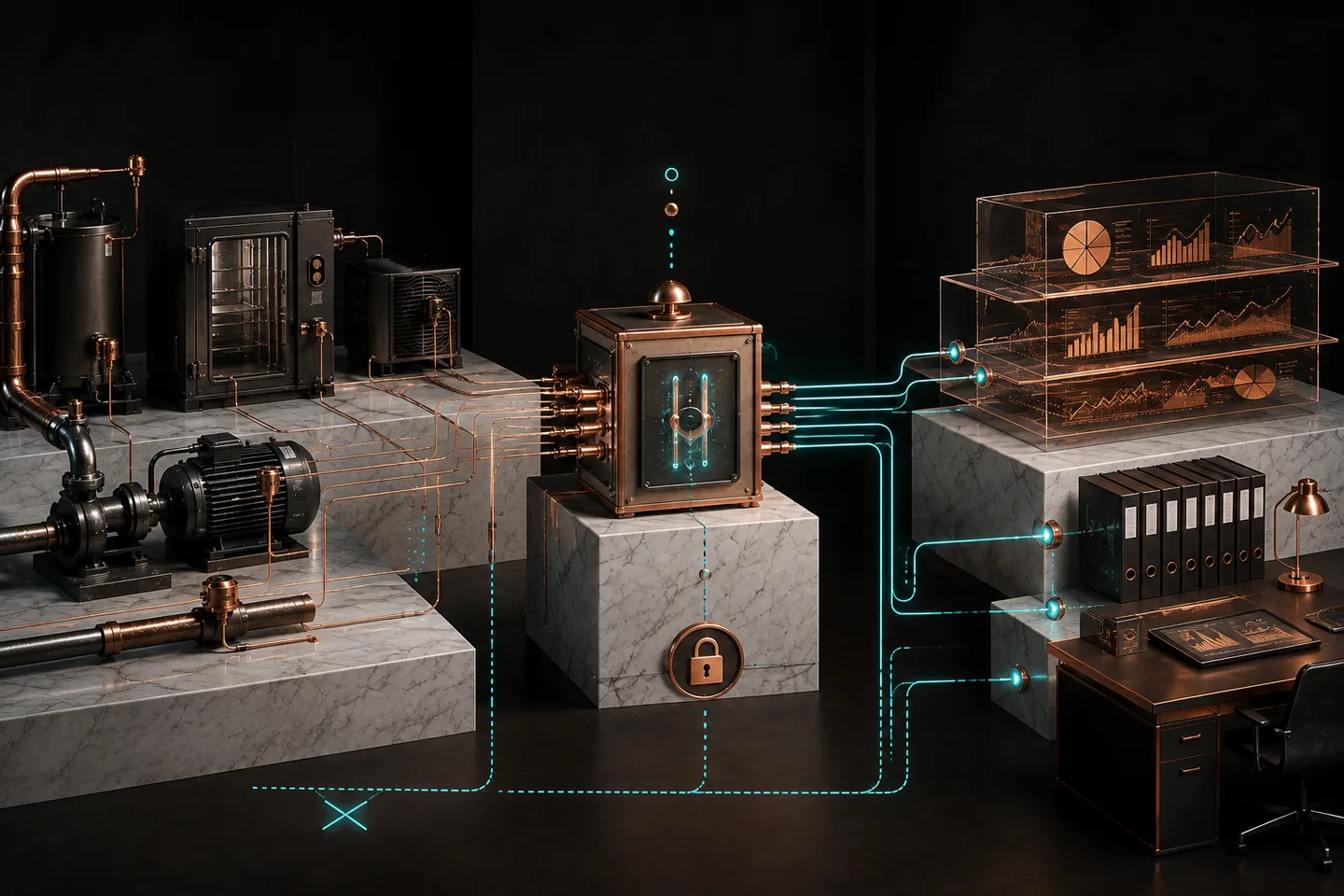
PLCs and controllers are designed around physical sequences, timing, and equipment state. ERP, MES, maintenance, quality, and analytics applications operate with different identities, transaction boundaries, latency, and failure behavior.
A dependable architecture connects these environments without allowing a delayed API, duplicate message, or unavailable cloud service to destabilize machine control.
Engineering consideration
Define the source and authority
Identify which controller tags and events are meaningful, which system owns job, product, asset, material, and completion state, and which data is observation versus command. Avoid turning every internal PLC tag into a public integration contract.
Engineering consideration
Use a bounded integration layer
A gateway or integration service can translate protocols, add context, validate freshness, buffer events, manage credentials, and expose a stable business-facing interface.
- Protocol and data contract
- Source timestamp and sequence
- Idempotency and duplicate handling
- Offline buffer and retry limits
- Authentication and network boundary
Engineering consideration
Reconcile partial outcomes
Define what happens when the PLC reports completion but the business transaction fails, arrives late, or conflicts with operator disposition. Preserve both source states and route unresolved differences to an accountable workflow.
Questions worth answering
Before selecting the technology
- Which system owns each state and identifier?
- What must continue if the business application is unavailable?
- How are duplicates, late events, and conflicts reconciled?
- Can the connection begin read-only?
The engineering decision
Connect controller data through an explicit integration boundary that preserves local control, source evidence, business context, and recoverable failure behavior.
The correct decision depends on the operating requirement, failure consequence, available evidence, and ability to act on the result. Technology should be selected after those constraints are understood.