

Control · Sequence · Integration
Turn operating rules into controlled actions, not hidden authority.
Industrial automation should make permitted behavior repeatable and exceptions visible while preserving the safety, manual control, and operating responsibility appropriate to the equipment.
Operating purpose
Why the business should care.
Automation can improve repeatability, response time, and operating visibility, but it also turns written or assumed rules into real actions. Those rules need to be explicit, testable, appropriately interlocked, and understandable to the people responsible for the process.
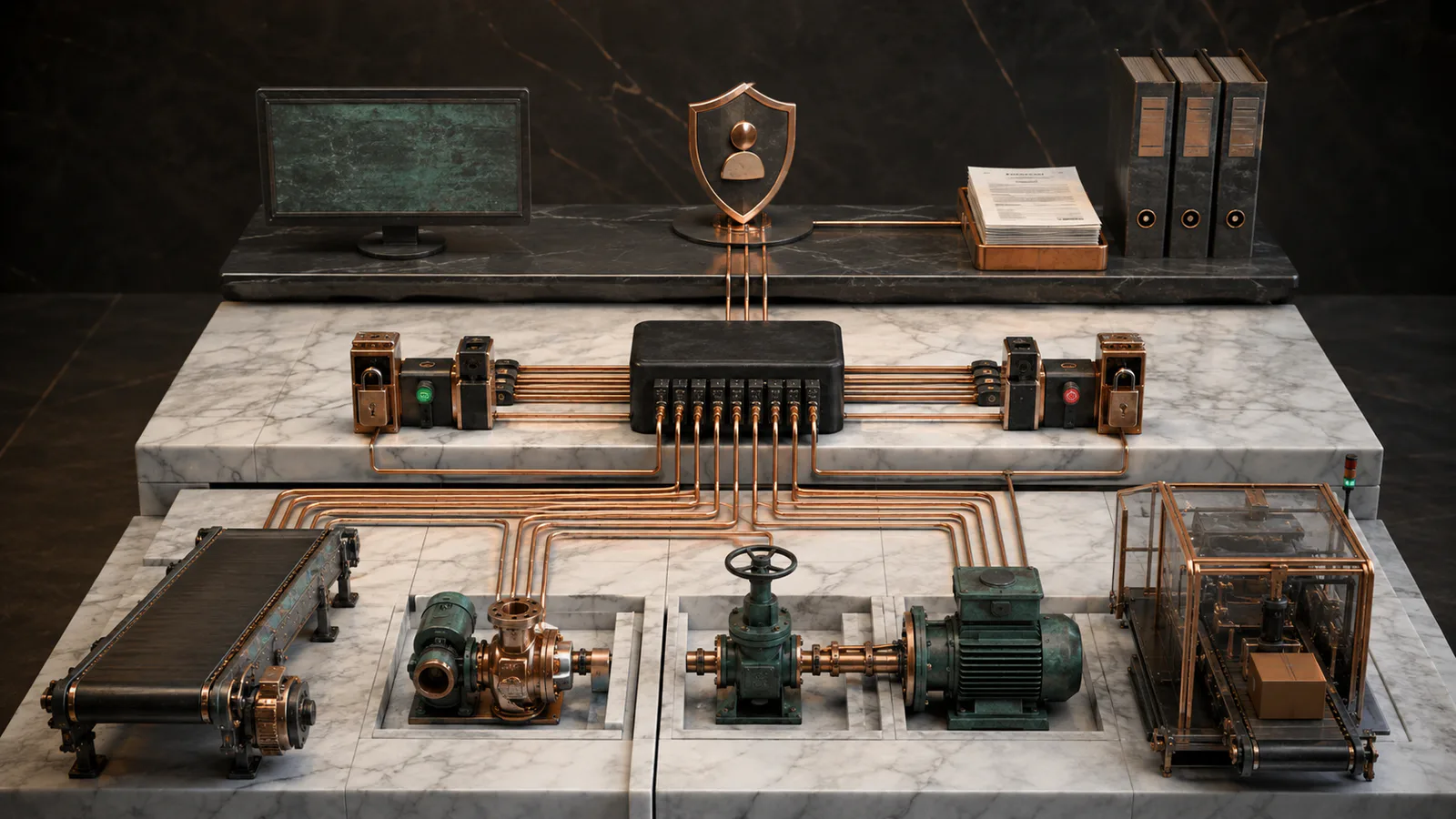
The strongest design separates machine control, supervisory coordination, business workflow, analytics, and AI assistance. Each layer receives only the authority and timing responsibility it can safely perform.
Useful capability
What can become visible or easier to coordinate.
Basic control
Scheduled operation, threshold response, interlocks, alarms, automatic start or stop, and repeatable sequences.
Supervisory operation
Central status, controlled operator commands, recipes, alarm management, history, and remote diagnostic context.
Business integration
Connect production plans, maintenance events, inventory, quality outcomes, and completed work to operational software.
Operator assistance
Explain alarms, retrieve approved procedures, summarize conditions, and prepare troubleshooting evidence without inheriting machine authority.
High-level approach
How the work is structured.
Define the sequence and safe state
Document permitted states, prerequisites, timing, interlocks, fault response, manual authority, and what safe interruption means.
Assign control to the right layer
Keep real-time and safety responsibilities in appropriate controllers; place coordination, history, and business integration above them.
Design interfaces and modes
Make automatic, manual, maintenance, degraded, and stopped modes explicit with current-state feedback and bounded commands.
Test normal and abnormal behavior
Verify startup, shutdown, sensor disagreement, actuator failure, communication loss, repeated commands, power recovery, and operator intervention.
Connect and reconcile business events
Publish useful state and outcomes without allowing a delayed ERP, cloud service, or AI tool to silently control the machine process.
Operating safeguards
How the business keeps control.
- Safety functions and required protective systems remain in appropriately designed and qualified control layers.
- Cloud connectivity and business applications do not become hidden prerequisites for local safe operation.
- Manual, maintenance, automatic, and degraded modes are distinguishable and permissioned.
- Remote commands require identity, authorization, current-state validation, confirmation, and outcome reporting.
- AI may interpret, detect, explain, or recommend; deterministic controls authorize machine actions.
Business evidence
Measurements used to support decisions.
Each measure is tied to a stable definition, source record, baseline, and named decision.
Engineering examples
How the connected operation works.
Business-integrated maintenance event
- Operating problem
- An equipment fault stops production, but maintenance learns about it through a delayed manual message.
- Information used
- Controller fault, asset identity, machine mode, recent conditions, production job, maintenance availability, and acknowledgement.
- Working approach
- The controller retains machine authority while a verified event creates a contextual work order and escalation; the response is reconciled to the fault state.
- Business value
- Faster coordination without allowing the maintenance or business system to bypass machine controls.
Controlled batch sequence
- Operating problem
- A repeatable process depends on operator memory and inconsistent manual timing.
- Information used
- Approved recipe, material confirmation, equipment state, interlocks, timers, quality checkpoints, and operator authority.
- Working approach
- Deterministic sequence logic manages permitted steps and safe stops; the supervisory layer records progress and requires approval for exceptions.
- Business value
- More consistent execution with visible exceptions and retained human authority where judgment is required.
Begin with the operating condition
Discuss what the operation needs to measure, connect, or control.
We can help establish the requirement, available evidence, practical architecture, and responsible next step.
Start a private conversation