

Controlled Industrial Intelligence · Engineering example
Root-Cause & Event Correlation Intelligence
Bring process alarms, equipment work, material lots, operator observations, and quality results onto a trustworthy timeline. Use the combined evidence to narrow what should be tested, without mistaking an event that happened nearby for a proven cause.
The operating challenge
The evidence for one failure lives in several systems.
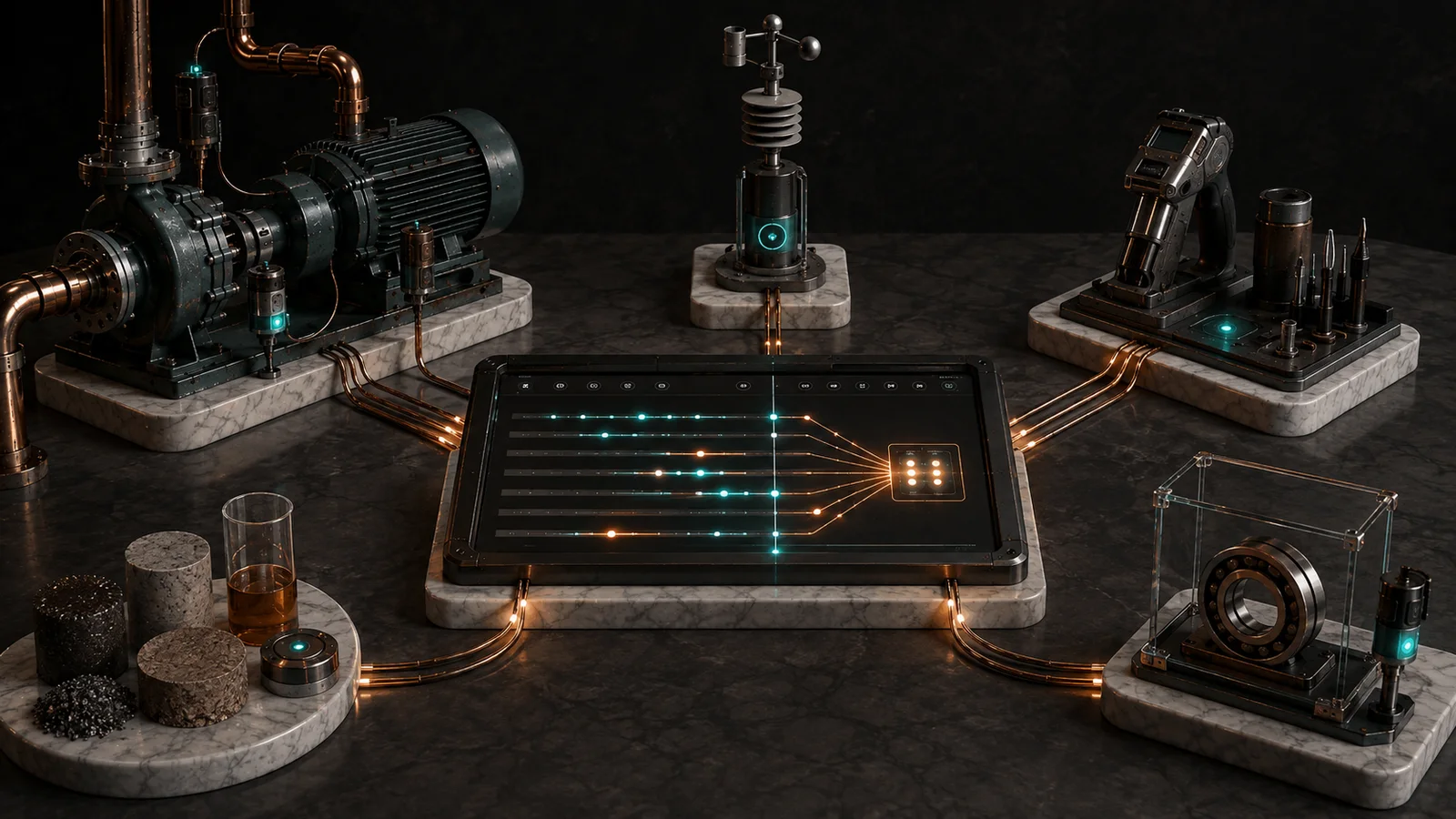
A quality rejection can be recorded in a laboratory system while a machine alarm sits in a historian, a filter change is buried in a maintenance ticket, and the actual material lot is recorded in an ERP transaction. By the time a team joins these records, clocks and identities may disagree. Event correlation shortens that reconstruction, but a sequence or statistical association still needs physical verification before anyone calls it the root cause.
Align identity
Equipment, job, lot, batch, shift, and work-order IDs must refer to the same physical event and scope.
Align time
Event time, entry time, time zone, delayed upload, and system-clock error can reverse apparent order.
Separate hypothesis from finding
A preceding alarm may be a symptom, consequence, or unrelated event. Record tests that confirm or reject each theory.
Why modernize: Teams can spend less time gathering screenshots and more time testing plausible mechanisms, reducing repeat incidents and improving the handoff from investigation to corrective action.
Illustrative operating example
Fill-volume rejects rise after a maintenance changeover.
This beverage-packaging scenario is illustrative. It is not a claim about a completed customer installation, an actual defect cause, or a measured improvement.
Imagine a filling line whose checkweigher begins rejecting more containers on Tuesday morning. Operators remember a short pressure alarm; the maintenance system shows a filter replaced the prior evening; production switched to a different bottle size and material lot around the same time. Any one could matter, or none could explain the rejects. A connected timeline reveals the order and affected runs, then asks the team to compare fill-head behavior, pressure stability, checkweigher calibration, container variation, and maintenance work before changing settings or blaming a supplier.
- Identify affected output.Define line, run, product, lot, rejection type, first confirmed bad unit, and last known good sample.
- Gather the timeline.Join quality measurements, machine alarms, setpoint changes, maintenance actions, material scans, and operator notes using source timestamps.
- Check the joins.Reconcile clock offsets, delayed records, lot genealogy, and maintenance ticket completion versus actual physical work time.
- Rank testable hypotheses.Compare the event sequence to plausible mechanisms such as pressure instability, fill-head setup, container geometry, or a weighing issue.
- Verify and close.Qualified teams test the equipment and product, document the finding, contain any affected output, and verify that a corrective action worked.
What the reviewer would see
Fill Line 3: evidence before cause
A linked timeline with competing explanations.
- Scope
- Run, product, bottle lot, rejected units, and first confirmed deviation.
- Events
- Pressure alarm, filter work, format change, and checkweigher trend with source times.
- Hypotheses
- Physical mechanism, supporting and contradicting evidence, next safe test.
- Finding
- Reviewer, test result, containment, action, and recurrence check.
Other high-priority situations
Different failures require different evidence chains.
Seal failures appear on one packaging run
Join seal temperature and pressure, package material lot, line speed, setup changes, and destructive-test results. Do not attribute a defect to a supplier simply because its lot arrived first.
Useful report: affected production window, competing causes, test results, and disposition.
Repeated pump trips after a plant modification
Align electrical trips, process demand, valve movement, control changes, and maintenance notes. A correlated change may point to a useful test, while qualified staff handle electrical and process safety.
Useful report: ordered trip context, verified mechanism, and recurrence after correction.
What a modernization would connect
Create an ordered, attributable investigation record.
The goal is not to dump every system into one dashboard. Establish identities, preserve original records, normalize time transparently, and link only events relevant to the affected product, equipment, and process window. The reviewer must be able to open the underlying evidence and see how a correlation was derived.
Required operating evidence
- Equipment, job, product, lot, batch, and material genealogy
- Original event time, entry time, time zone, and clock quality
- Process, alarm, setpoint, and equipment-state history
- Maintenance work, parts, testing, and actual work time
- Quality results, sample and inspection time, and disposition
- Operator observations, hypothesis tests, and verified finding
Corrections should append a reason and reviewer, not overwrite original timestamps or notes.
Connected technical layers
- Read-only historian, MES, maintenance, ERP, and quality records
- Identity and time-reconciliation layer
- Event window and candidate relationship engine
- Evidence-linked case file with reviewer feedback
- Corrective-action and recurrence tracking
A system may rank likely relationships but cannot authorize a quality release or declare a cause unilaterally.
Every event retains its source. A missing work order, late laboratory result, or unreliable clock stays visible as an evidence gap.
Where automation and AI fit
Automate reconstruction and suggest tests, not verdicts.
Deterministic automation
Resolve IDs, convert times with provenance, collect events in the bounded investigation window, deduplicate repeats, and link affected output to material and equipment history.
Analytical methods
Compare candidate events to prior similar incidents, quantify timing and recurrence, and test whether a relationship persists when product or operating state changes.
Evidence-linked AI assistance
Summarize maintenance notes and event sequences with links to sources, list alternate mechanisms, and identify missing tests. It must label an unverified cause as a hypothesis.
Human operating authority
Process, maintenance, quality, and safety owners choose safe tests, contain product, approve corrective work, and sign off on findings and disposition.
How we examine a proposed solution
AI advisors challenge whether the story is supported.
These Adaptiv Stratum AI advisory roles support bounded design review and do not assign blame or approve corrective action.
Argus
Checks event identity, time normalization, and source lineage.
Hephaestus
Tests physical plausibility of fill-system mechanisms.
Pythia
Challenges recurrence and statistical association claims.
Aegis
Looks for missing records, reversed chronology, and false causation.
Clio
Defines investigation time and recurrence measures.
Themis
Reviews attribution, records access, and approval boundaries.
What becomes visible
Make the timeline inspectable and the finding falsifiable.
A useful investigation report shows both evidence for and against each explanation, the tests performed, and what remains unknown. It should support handoff across operations, maintenance, quality, and leadership without turning a plausible narrative into an unsupported certainty.
Per-incident case file
- Affected units and last-known-good boundary
- Ordered event timeline with original source links
- Clock corrections and missing or delayed records
- Hypotheses, contradictory evidence, and safe next tests
- Finding, containment, corrective action, and sign-off
Learning across incidents
- Time from detection to evidence-ready case
- Time to verified finding
- Repeated failure modes by equipment or product
- Corrective actions with recurrence outcome
- Unresolved cases and documentation gaps
- False associations rejected after testing
Correlation may prioritize a test. It does not prove the mechanism, product impact, or responsibility of an individual.
Operating safeguards
Keep provenance and human verification intact.
- Source records retained and accessible to reviewers
- Event and entry timestamps kept distinct
- Product, material, and equipment identity reconciled
- Hypotheses visibly separate from verified findings
- Contradictory and missing evidence shown
- Quality and safety procedures remain authoritative
- No personnel blame inferred from logs or timing
- Corrective action verified for recurrence
A practical first phase
Reconstruct three recent recurring incidents.
- Select the failure class.Choose a recurring quality or downtime issue with known impact and at least one reviewed historical case.
- Map four source systems.Identify equipment history, production genealogy, maintenance work, and quality evidence with their clocks and IDs.
- Build ordered case files.Preserve original records and list unresolved joins or absent events.
- Compare with expert review.Ask the accountable team which hypotheses are physically plausible and what test would discriminate among them.
- Measure utility.Compare reconstruction time, verified findings, unresolved gaps, and recurrence after action before scaling.
Begin with a repeat problem
Which failure sends your team to four systems before it can ask the first useful question?
One evidence-ready case can reveal the value of joining those records.
Evidence and further reading
Linked records support investigation, not automatic certainty.
These NIST sources inform the approach. The filling-line example is illustrative, not an Adaptiv Stratum customer case study.
- NIST: Manufacturing Traceability Meta-Framework describes interoperable, ordered provenance links across systems.
- NIST: Labeling Maintenance Logs for Root-Cause Analysis examines structuring technician notes for diagnostic learning.
- NIST: Knowledge-Based Manufacturing Diagnosis frames root-cause analysis across organizational and technical levels.