

Controlled Industrial Intelligence · Engineering example
Process Anomaly & Deviation Intelligence
Compare each production run with a qualified baseline for its recipe, mode, and conditions. Detect combinations of signals that are changing together, show why they merit review, and keep process and quality decisions with the responsible team.
The operating challenge
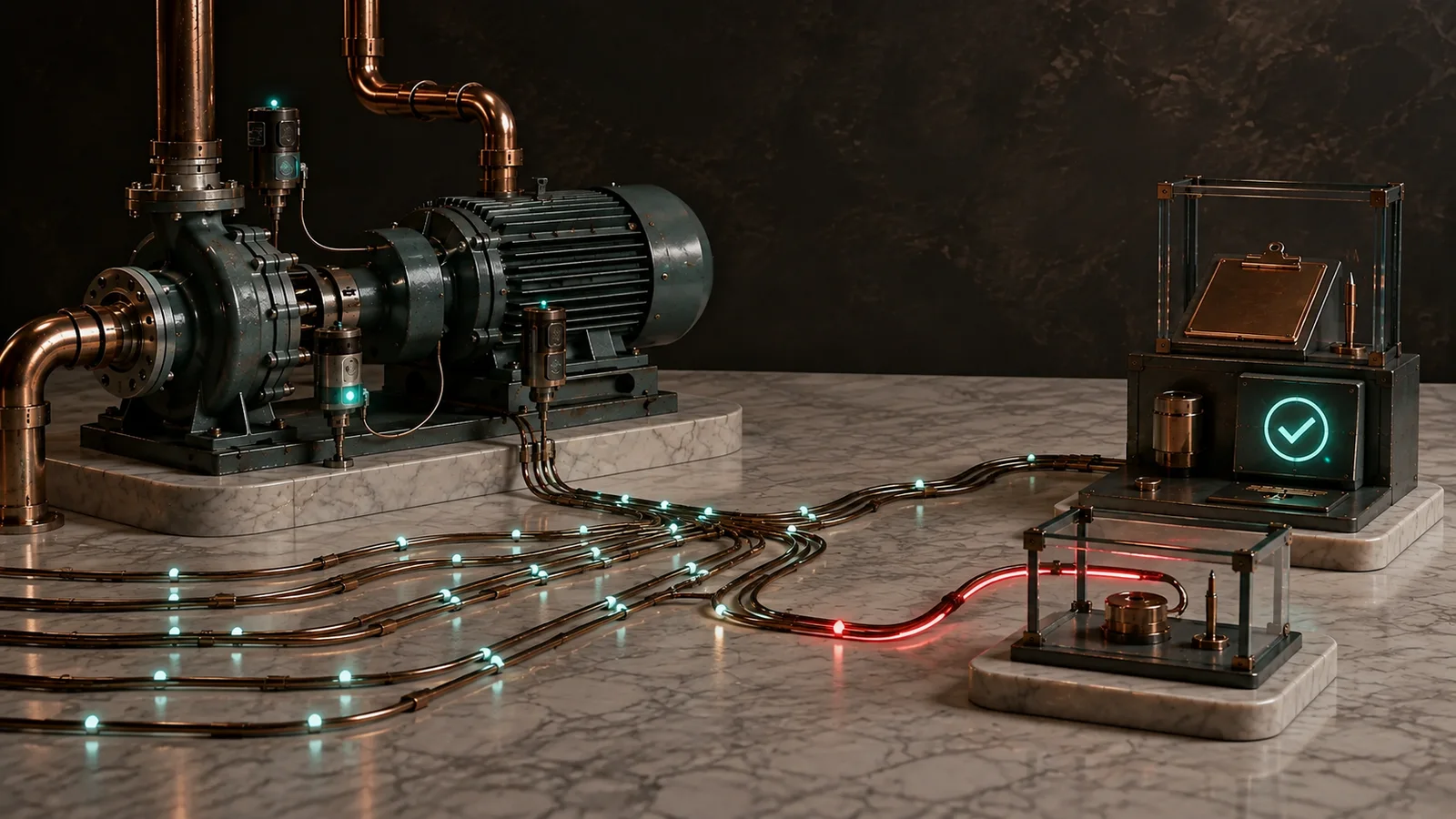
Every signal may be in range while the process is moving away from normal.
A line can remain inside separate pressure, temperature, and speed alarm limits yet behave differently from a stable run of the same product. A generic anomaly score is not enough to justify intervention. The team needs the comparable operating mode, trusted measurements, timing, related events, and an explanation of what changed. Startups, cleanings, recipe transitions, and maintenance periods should not be judged against steady production.
Compare like with like
Recipe, batch, material, machine configuration, and phase define the valid baseline. Otherwise normal change becomes noise.
Qualify the evidence
Missing or stale tags, bad clocks, sensor drift, and changed scaling can produce a false deviation.
Show the decision boundary
Detection asks for investigation. Control, product hold, and release remain governed by approved procedures and people.
Why modernize: A useful early warning narrows investigation before scrap or downtime grows, while fewer nuisance alerts protect attention for genuine problems.
Illustrative operating example
A drying line slowly changes under an apparently stable recipe.
This drying-line scenario is illustrative. It is not a claim about a completed customer installation, an actual quality finding, or guaranteed early warning.
Imagine a manufacturer drying a coated material on a continuous line. The recipe is unchanged, and each displayed temperature remains within its individual limit. Over several shifts, however, exhaust humidity rises while fan current and belt-speed adjustments gradually move away from comparable runs. Finished-product moisture begins to vary. The signal may reflect wetter incoming material, fouled airflow, a changed sensor, or another cause. A well-designed anomaly service groups the evidence by recipe and production phase, checks input quality, and brings the change to a qualified operator before suggesting any root cause.
- Define comparable operation.Identify the same product, approved recipe, equipment setup, steady-run phase, and incoming-material range.
- Qualify the data.Check humidity, temperature, fan, speed, and quality readings for freshness, calibration, units, and event alignment.
- Detect a sustained difference.Use approved limits and state-specific change detection before adding a multivariable model. Require persistence and enough complete data.
- Present the evidence.Show which signals changed, when, against which comparable runs, and what maintenance or material events coincide.
- Investigate and close.Operations and quality staff check incoming material, airflow, instruments, and product samples, then record a verified finding or a false alarm.
What the reviewer would see
Dryer Run D-204: sustained deviation
A candidate for review, not an automated diagnosis.
- Comparable state
- Recipe, product, phase, material range, and reference runs.
- Evidence
- Aligned humidity, fan current, speed, temperature, and quality trend.
- Uncertainty
- Sensor quality, missing intervals, model coverage, and alternate explanations.
- Decision
- Reviewer, physical check, sample result, action, and verified outcome.
Other high-priority situations
Deviation methods must follow the process.
Packaging line speed and reject pattern drift
Compare rejects with actual speed, format, material lot, and changeover phase. A rising reject ratio during a new carton setup is not the same event as steady-run deterioration.
Useful report: comparable baseline, affected units, first change, and confirmed cause.
Compressed-air system changes under stable demand
Link pressure, compressor state, flow, and production schedule. Flag a sustained relationship change, then inspect instrumentation and leaks before dispatching work.
Useful report: demand-normalized trend, energy impact estimate, and maintenance finding.
What a modernization would connect
Build a state-aware baseline and an evidence trail.
The workflow begins with operating context and qualified telemetry, not a model trained on every historical point. Stable periods become baseline candidates only after operators validate their status and data quality. Model updates are versioned and reviewed when recipes, equipment, or sensing change.
Required operating evidence
- Equipment, product, recipe, phase, material, and configuration IDs
- Synchronized process and equipment signals with quality flags
- Alarm, intervention, cleaning, maintenance, and shift events
- Finished-product measurements and sampling latency
- Baseline selection, model version, and threshold rationale
- Investigation finding, action, and outcome
A reference run should be known-good for the specific comparison, not simply common in the archive.
Connected technical layers
- Read-only approved historian and production events
- Operating-mode and recipe context
- Deterministic limits and state-specific change detection
- Optional validated multivariable analysis
- Evidence-linked review and feedback workflow
Existing control and protection stay in their proper systems. The intelligence layer cannot silently change a setpoint.
When a new recipe or configuration falls outside the qualified baseline, show insufficient context instead of forcing an anomaly score.
Where automation and AI fit
Detect a candidate change; require proof before a conclusion.
Deterministic automation
Apply approved process limits, state filters, minimum duration, data completeness, and alert routing. Suppress duplicate notifications without hiding the original event.
Analytical methods
Use change detection or multivariable patterns only within validated operating modes. Compare precision, missed events, and warning time against a simple rule baseline.
Evidence-linked AI assistance
Summarize the sequence and competing explanations with cited measurements and maintenance events. It must not state a root cause that has not been verified.
Human operating authority
Operators, engineering, and quality staff choose tests, intervene under procedure, place holds, and confirm product or equipment disposition.
How we examine a proposed solution
AI advisors question comparability, evidence, and consequences.
These Adaptiv Stratum AI advisory roles support bounded design review; they do not authorize process changes.
Argus
Checks run identity, timestamps, and signal lineage.
Hephaestus
Examines the physical dryer, airflow, and maintenance context.
Pythia
Challenges baseline selection and anomaly-model performance.
Aegis
Looks for false positives, missing data, and unsafe inference.
Clio
Defines warning lead time and verified-finding measures.
Themis
Reviews approval, audit, and product-disposition boundaries.
What becomes visible
A useful alert explains its comparison.
An operator should see what changed, relative to which valid baseline, what evidence is missing, and what action is requested. A model score by itself is not an operating instruction.
Per-deviation view
- Equipment, run, recipe, phase, and baseline identity
- First change, duration, magnitude, and contributing signals
- Data-quality and context gaps
- Related maintenance, material, and quality events
- Reviewer, investigation, and verified finding
Program effectiveness view
- Useful warning lead time
- Confirmed versus false or unresolved alerts
- Missed deviations found by operators or quality checks
- Investigation time and recurring causes
- Baseline coverage by product and mode
- Changes in scrap, downtime, or rework only when attributable
The dashboard should make unknown outcomes visible; an unreviewed anomaly is not a confirmed defect or a successful detection.
Operating safeguards
Keep detection bounded by known-good context.
- Qualified, timestamped inputs and visible gaps
- Recipe, phase, product, and configuration-specific baselines
- Documented model coverage and version control
- Separate planned transitions from steady operation
- False-alert and missed-event review with operators
- No automatic setpoint, safety, or release authority
- Investigation result and corrective action retained
- Revalidation after major process or sensor changes
A practical first phase
Pilot one stable product and one costly deviation.
- Choose the question.Select a recurring scrap, rework, or downtime event with enough historical context to review.
- Map comparable runs.Identify product, recipe, phase, equipment state, material, and known-good periods.
- Audit the signals.Check clocks, gaps, units, calibration, and quality-event coverage.
- Run rules and model in shadow.Compare a simple state-specific rule with an optional multivariable method without influencing control.
- Review outcomes.Measure useful lead time, false alerts, missed events, investigation effort, and verified findings before expansion.
Begin with a recurring exception
Which process problem is usually noticed only after finished-product testing?
That is a candidate for a carefully bounded earlier signal.
Evidence and further reading
Anomaly methods need context and uncertainty review.
These NIST sources inform the approach. The dryer example is illustrative, not an Adaptiv Stratum customer case study.
- NIST: Manufacturing Monitoring Under Uncertainty describes how measurement, process, and model uncertainty interact.
- NIST: Monitoring, Diagnostics, and Prognostics for Manufacturing frames trustworthy sensing and analytics for operating decisions.
- NIST: AI-Enhanced Manufacturing Process Monitoring describes research on detecting and mitigating process errors.