

Sensors, IoT & Telemetry · Engineering example
Water, Fluid & Utility Network Telemetry
Connect flow, pressure, level, valve, and pump observations to the actual network map and operating schedule. A trustworthy balance distinguishes legitimate use, storage changes, instrument error, and possible loss before anyone acts on an alert.
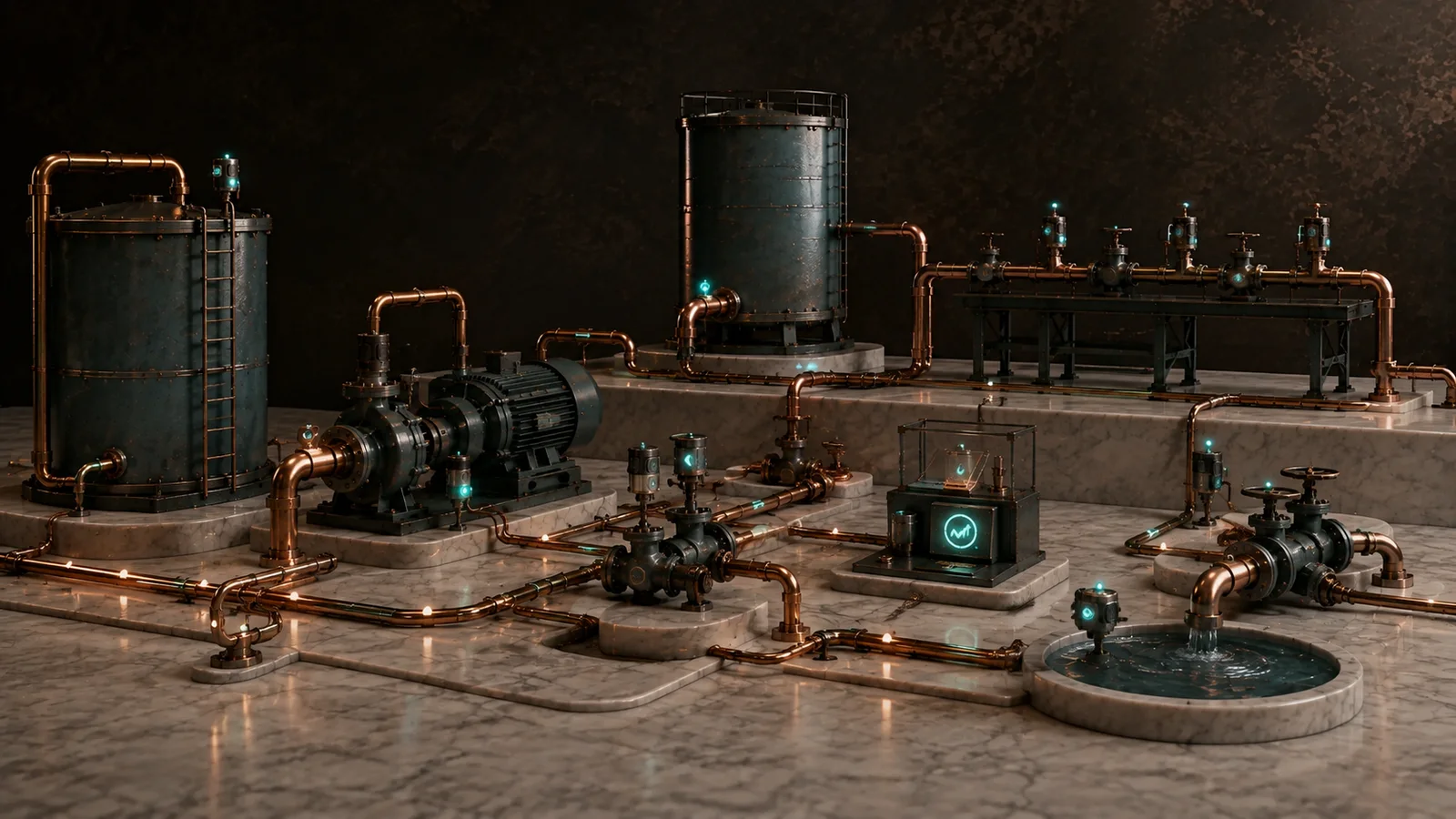
The operating challenge
An unexplained difference is not automatically a leak.
A facility may meter water or another utility at its main inlet but not know which building, process, or branch accounts for a change. Supply minus measured use can represent real loss, unmetered consumption, tank inventory change, bypass flow, clock mismatch, or meter error. Pressure can change with pump state and demand even when the network is sound. Reliable telemetry starts with a physical balance boundary and documented instruments.
Network maps drift
A bypass, seasonal connection, or normally closed valve may be missing from the diagram. The calculated balance is only as good as the known flow paths.
Meters disagree for reasons
Different accuracy, units, sampling windows, and totalizer resets can create an apparent loss. Validate instrumentation before dispatching a leak crew.
Pressure needs context
A low reading may reflect legitimate high demand, a pump transition, sensor position, or a fault. Operations must review the system state.
Why modernize: Find abnormal consumption or network deterioration earlier, direct inspection to a smaller area, and verify repair without turning every imbalance into a false emergency.
Illustrative operating example
A campus utility loop shows an overnight flow increase.
This campus process-water situation is illustrative. It is not a claim about a completed customer installation, proven leak location, or measured water savings.
Imagine a site with a process-water inlet, two buildings, a storage tank, and a branch serving cooling equipment. The main meter shows higher overnight flow, but production use is low. A naive leak alert would point to the entire loop. A better review reconciles branch totalizers, tank level, scheduled cooling makeup, valve positions, and recent maintenance. One branch remains elevated under similar night operations. Facilities then verifies meter condition and walks that section for a possible open bypass or leak. The evidence narrows the search; it does not prove the cause remotely.
- Define the balance boundary.Map every known inlet, outlet, storage element, bypass, and meter. Identify unmetered use and approved operating exceptions.
- Align the clocks and units.Convert readings to a common interval and volume unit, check totalizer rollover and data gaps, and confirm meter direction.
- Account for inventory.Include tank level change, known blowdown or makeup, and scheduled nighttime use before interpreting the residual.
- Review a smaller segment.Compare branch flow and pressure under similar pump and valve states. A responsible operator validates the abnormal pattern.
- Inspect and verify.Qualified staff locate and repair any physical issue or correct a bad meter. Recalculate the balance after the intervention and record uncertainty that remains.
What the reviewer would see
Process-water loop: overnight balance
The report distinguishes observed volumes from a suspected loss.
- Boundary
- Main inlet, two metered branches, tank, cooling makeup, and known bypasses.
- Operating context
- Night schedule, pump and valve state, tank-level change, and meter quality.
- Residual
- Unexplained volume with uncertainty and candidate measurement gaps.
- Outcome
- Human inspection, confirmed cause, corrective work, and after-balance.
Other high-priority situations
The same network model can answer several questions.
Pressure loss under peak use
Compare pressure at known nodes with demand, pump speed, valve state, and tank level. A model may isolate a likely segment, but a field test determines whether restriction, control behavior, or measurement is responsible.
Useful report: pressure and flow profile, operating state, and verified field finding.
Cooling or compressed-air utility runs during idle time
Look for sustained use when scheduled production is off, then check legitimate standby, purges, and bypasses. Different fluids and hazards require their own approved instrumentation and response procedures.
Useful report: off-hours demand, expected standby, investigation, and post-work comparison.
What a modernization would connect
Make the physical network the data model.
The first architecture decision is the system boundary: what comes in, what leaves, what is stored, and which paths are unmeasured. Instrument selection and installation depend on fluid, pipe, access, process continuity, and site safety. Analytics should be read-only until a separately engineered control project is approved.
Required operating evidence
- Current piping map, source, branch, tank, outlet, bypass, and valve identity
- Flow and totalized volume, pressure, level, and temperature where useful
- Meter direction, calibration, range, units, and timestamp quality
- Pump, valve, treatment, and process operating state
- Scheduled legitimate use, storage change, and known discharge
- Inspection, repair, and meter-correction history
An unknown flow path is a model gap, not automatically a physical loss.
Connected technical layers
- Approved meters and sensors at defensible boundaries
- Protected read-only collection with local buffering
- Versioned network topology and time-aligned balance logic
- Human review of persistent residuals and pressure anomalies
- Work-request integration and verified closure record
Local pressure protection, water-quality controls, and operating procedures remain independent.
Use the same time window for every volume term. A tank filling while branch meters are sampled at different intervals can create a misleading residual.
Where automation and AI fit
Automate balance and anomaly review, not valve authority.
Deterministic automation
Normalize units, reconcile interval volumes, include tank inventory change, test meter freshness, and flag a persistent residual outside an approved tolerance.
Analytical methods
Compare night flow or pressure behavior under similar operating states. A model can rank likely segments for inspection, with uncertainty from unmetered use visible.
Evidence-linked AI assistance
Prepare an investigation summary with network map references, affected intervals, alternate explanations, and past work. It must not assert a leak location as fact without field confirmation.
Human operating authority
Operators and utility engineers choose isolation, repair, sampling, and return-to-service steps according to the fluid and site procedures.
How we examine a proposed solution
AI advisors test the balance before promising a finding.
These Adaptiv Stratum AI advisory roles support bounded design review. They do not operate valves or replace field technicians.
Argus
Checks meter identity, units, totalizers, timestamps, and gaps.
Hephaestus
Reviews pumps, storage, piping, and physically plausible flow paths.
Pythia
Tests anomaly methods against a transparent balance.
Aegis
Challenges false leak claims from bad meters or missing paths.
Clio
Defines before-and-after repair and meter-validation evidence.
Themis
Reviews response rights and any water-quality or service obligations.
What becomes visible
Report the balance with its uncertainty.
The operational report should explain which interval and boundary produced an abnormal result and what evidence was missing. A trend in unaccounted volume is a reason to investigate, not a final attribution.
Network interval view
- Boundary and topology version
- Inflow, measured branch use, discharge, and inventory change
- Residual and measurement uncertainty
- Pump, valve, and process state
- Sensor freshness, calibration, and data gaps
Investigation and stewardship view
- Persistent residuals by segment and comparable schedule
- Pressure anomalies with demand context
- Meter checks, field inspections, and confirmed findings
- Repair time and post-work balance
- Known unmetered uses and topology changes
- Consumption per relevant unit of production or service
Do not state recovered water or cost savings without a validated pre/post boundary and comparable operating conditions.
Operating safeguards
Keep measurement, control, and physical service separate.
- Approved meter installation for the actual fluid and pressure range
- Versioned network map including bypasses and storage
- Units, flow direction, totalizer rollover, and clock checks
- Visible uncertainty for unmetered paths and missing data
- Persistent-event thresholds reviewed with operators
- Read-only analytics with no automatic valve action
- Qualified field confirmation before calling a loss a leak
- Post-repair balance and condition verification
A practical first phase
Choose one metered branch and an off-hours question.
- Draw the boundary.Confirm inlet, outlets, storage, known legitimate draws, and candidate measurement gaps.
- Validate the meters.Check sizing, units, direction, totalizer behavior, accuracy, and clock alignment.
- Observe representative periods.Build an interval balance across normal production and off-hours with pump and valve context.
- Investigate one persistent residual.Facilities staff check bypasses, planned use, meter condition, and the physical branch before repair.
- Verify the result.Compare the same boundary after the finding is addressed and decide whether more segmentation has value.
Begin with a network question
Where does measured supply stop matching known use?
A small balance with honest uncertainty can direct the next inspection.
Evidence and further reading
Balance first, then locate and verify.
These primary sources inform the approach. The campus utility example is illustrative, not an Adaptiv Stratum customer case study.
- DOE: Distribution-System Leak Detection explains the need for a water balance and appropriate detection approach across system sizes.
- AWWA: Water Loss Control distinguishes real losses from apparent losses due to measurement and accounting.
- DOE: Distribution-System Audits, Leak Detection, and Repair places metering and field response inside a broader loss-control program.