

Sensors, IoT & Telemetry · Engineering example
Environmental & Facility Condition Intelligence
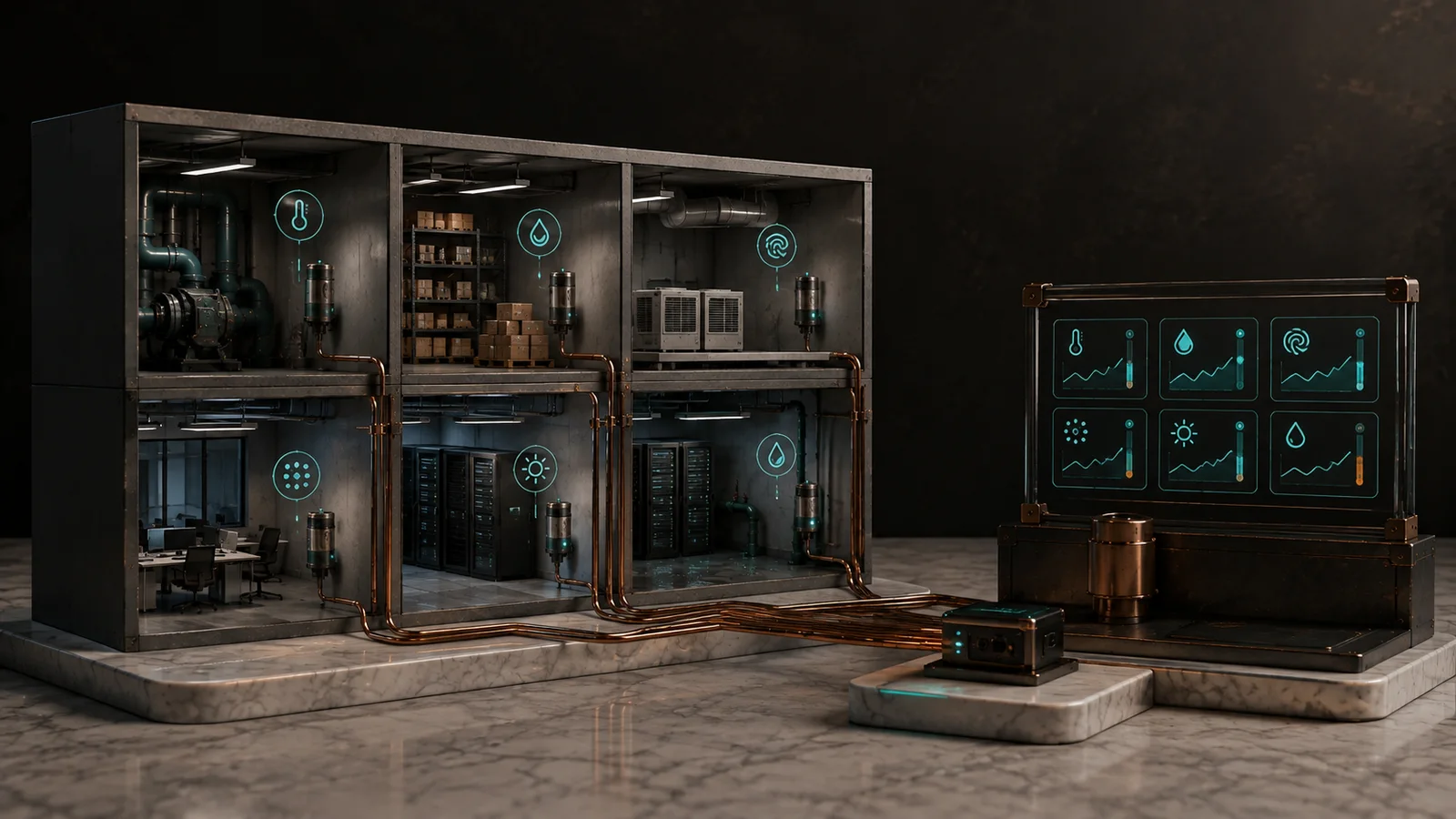
Connect temperature, humidity, moisture, and equipment-state observations across a facility so a changing condition is investigated in context. Keep sensor limitations visible and give facility staff a traceable path from observation to inspection and verified correction.
The operating challenge
A floor average can hide a local problem.
A facility dashboard may show acceptable average temperature while one room has recurring humidity, a wet ceiling, or an air-handling schedule that no longer matches use. A single sensor cannot explain whether the cause is placement, an HVAC fault, outdoor weather, occupancy, a plumbing leak, or a building-envelope issue. Facility teams need a map of conditions, assets, time, and response, not just more colored tiles.
Measurements are local
A sensor near a diffuser, window, or heat source may not represent the whole zone. Placement and calibration belong in the record.
Conditions have causes
High relative humidity alone does not identify a leak, inadequate ventilation, or mold. Inspection and operating context are needed.
Handoffs lose history
An occupant complaint, maintenance ticket, and BAS alarm can describe the same event yet remain disconnected across shifts and contractors.
Why modernize: Help staff find sustained, local excursions earlier, assign inspection to the right person, and verify whether the correction worked. Do not turn a sensor reading into a medical or building-condition diagnosis.
Illustrative operating example
One office zone stays humid after the cooling cycle ends.
This office-zone situation is illustrative. It is not a claim about a completed customer installation, indoor-air-quality certification, or measured health outcome.
Imagine a multizone office where occupants of Zone B report a musty odor on some mornings. A wall sensor shows periodic humidity increases, but the building-wide average looks ordinary. The facility manager also sees an air-handler runtime change and a recent ceiling stain. The responsible response is not to declare a cause from the graph. It is to check the sensor and room, compare outdoor conditions and equipment operation, inspect moisture sources, document findings, and follow the facility's established response process.
- Validate the zone measurement.Confirm sensor location, calibration, timestamp, and agreement with a qualified spot check. Note nearby doors, supply air, and heat sources.
- Build the context window.Join zone temperature and humidity with outdoor conditions, air-handler mode, schedule, occupancy pattern, and recent maintenance events.
- Investigate physically.Facility personnel inspect the stained area, condensate path, plumbing, and air delivery as appropriate. A qualified specialist assesses any suspected building-material or air-quality issue.
- Assign and record action.Link the condition and complaint to one work request with owner, inspection finding, corrective action, and communication to affected occupants.
- Verify after correction.Compare the same zone under similar weather and use, review recurrence, and keep unresolved readings open for further investigation.
What the reviewer would see
Zone B: condition and investigation
The record connects measurements to staff findings without pretending to diagnose a building from one sensor.
- Observation
- Zone humidity and temperature trend, sensor health, location, and outdoor context.
- Related evidence
- Air-handler state, occupant report, ceiling observation, and work history.
- Response
- Assigned inspection, finding, action, and occupant communication.
- Verification
- Comparable-condition follow-up and documented recurrence or closure.
Other high-priority situations
One platform can support different facility questions.
Repeated freeze-risk exposure
Compare plant-room temperature with outdoor weather, heating availability, and sensor placement. A sustained condition can prompt facility inspection before a pipe or process is affected.
Useful report: duration, affected zone, heating state, acknowledgement, and verified response.
Ventilation schedule does not match use
Compare occupied hours, approved schedules, equipment status, and representative environmental measurements. Staff verify whether a schedule change, equipment issue, or measurement problem explains the mismatch.
Useful report: occupied windows, equipment state, complaints, and approved adjustment.
What a modernization would connect
Map a measurement to a real place and responsible asset.
A practical design begins with a zone and asset register, suitable sensor placement, and a documented response workflow. The data layer can expose patterns, but building automation and emergency protection must retain their independent functions.
Required operating evidence
- Floor, zone, room use, affected occupants, and responsible equipment
- Temperature, humidity, moisture or leak observations as justified
- Sensor location, accuracy, calibration, and data freshness
- Outdoor conditions, operating schedule, and air-handler state
- Complaint, inspection, maintenance, and correction records
- Defined local limits and persistence rules with effective versions
A missing sensor or unverified location is reported as a data-quality issue, not a healthy zone.
Connected technical layers
- Approved facility sensors and read-only BAS observations
- Zone and equipment map with change control
- Time-series record and contextual event joins
- Work request and human acknowledgement workflow
- Role-appropriate dashboard and evidence-linked follow-up
The analysis layer does not issue unreviewed HVAC commands or replace local alarms.
Use a clearly defined review window. A short door-opening spike and a sustained room condition should not trigger the same response.
Where automation and AI fit
Automate detection and handoff; let people diagnose the space.
Deterministic automation
Check sensor freshness, apply approved zone limits with persistence, correlate equipment state, and open one traceable inspection request for a sustained excursion.
Analytical methods
Compare similar outdoor and occupancy conditions to find recurring patterns. A model can prioritize investigation but should show which observations support its suggestion.
Evidence-linked AI assistance
Summarize the zone timeline, prior work orders, and missing facts for facility staff. Do not label an odor, moisture condition, or occupant symptom as a diagnosis.
Human operating authority
Facility staff inspect and respond. Qualified building, mechanical, or environmental professionals determine causes and corrective work where required.
How we examine a proposed solution
AI advisors check what a sensor can and cannot say.
These Adaptiv Stratum AI advisory roles support bounded design review. They do not replace facility inspections or professional assessments.
Argus
Tests sensor identity, zone mapping, and timestamp continuity.
Hephaestus
Reviews HVAC operating states and physical measurement limits.
Pythia
Assesses whether seasonal comparison adds value beyond simple rules.
Aegis
Challenges unsupported diagnosis, stale data, and false reassurance.
Clio
Defines a pilot around response time and recurrence evidence.
Themis
Clarifies who may see reports, act, and communicate with occupants.
What becomes visible
Keep the zone, duration, context, and response together.
A facility report should tell staff where a condition occurred, how long it persisted, which equipment served the area, what was inspected, and whether the issue recurred under comparable use.
Zone incident view
- Zone, sensor location, readings, quality, and observation interval
- Outdoor conditions, occupancy pattern, and equipment state
- Complaint or physical observation with recorded source
- Owner, acknowledgement, inspection finding, and action
- Post-work verification and unresolved uncertainty
Facility program view
- Duration and recurrence of defined excursions by zone
- Sensor outages, calibration status, and measurement coverage
- Response and closure times by issue type
- Repeat conditions after maintenance
- Seasonal and schedule-adjusted comparisons
- Open investigations and specialist referrals
Avoid ranking buildings or declaring compliance from incomplete coverage. A chart is a prompt to investigate, not proof that every room is safe or comfortable.
Operating safeguards
Treat uncertainty as part of facility stewardship.
- Document sensor placement, calibration, and representative coverage
- Show freshness, outages, and conflicting readings
- Use zone-specific limits approved by responsible staff
- Separate short transients from persistent conditions
- Link complaints and inspections without inferring a cause
- Keep building safety and BAS control independent
- Protect occupant details and role-limit access
- Require a documented follow-up after corrective work
A practical first phase
Pilot one zone with a known recurring concern.
- Define the question.Choose a persistent humidity, temperature, or moisture concern with a real facility owner and response process.
- Walk the space.Confirm zone boundaries, sensor locations, equipment relationships, occupant reports, and physical inspection needs.
- Build a read-only record.Collect observations, BAS state, weather, and work history with visible data-quality flags.
- Run a supervised response.Facility staff review sustained excursions and record inspection, action, and communication.
- Measure recurrence.Compare similar conditions after the intervention and expand only if the data improves response without overclaiming.
Begin with one zone
Which condition keeps coming back without a clear explanation?
A small, well-instrumented investigation can make the next facility decision more reliable.
Evidence and further reading
Measure carefully, then inspect and verify.
These EPA sources inform the method. The office-zone scenario is illustrative, not an Adaptiv Stratum customer case study.
- EPA: Building Air Quality Guide describes facility profiles, investigation, and management of indoor conditions.
- EPA: Moisture Control Guidance addresses moisture investigation and building operation and maintenance.
- EPA: Siting and Installing Air Sensors explains why placement and nearby sources affect environmental measurements.