

AgTech & Controlled Environments · Engineering example
Smart Irrigation and Nutrient Control
Give growers a reliable view of water delivery, root-zone response, and nutrient-solution quality before changing a recipe. Connect crop stage, source water, irrigation events, substrate or return measurements, equipment state, and drainage while keeping agronomic decisions with the grower.
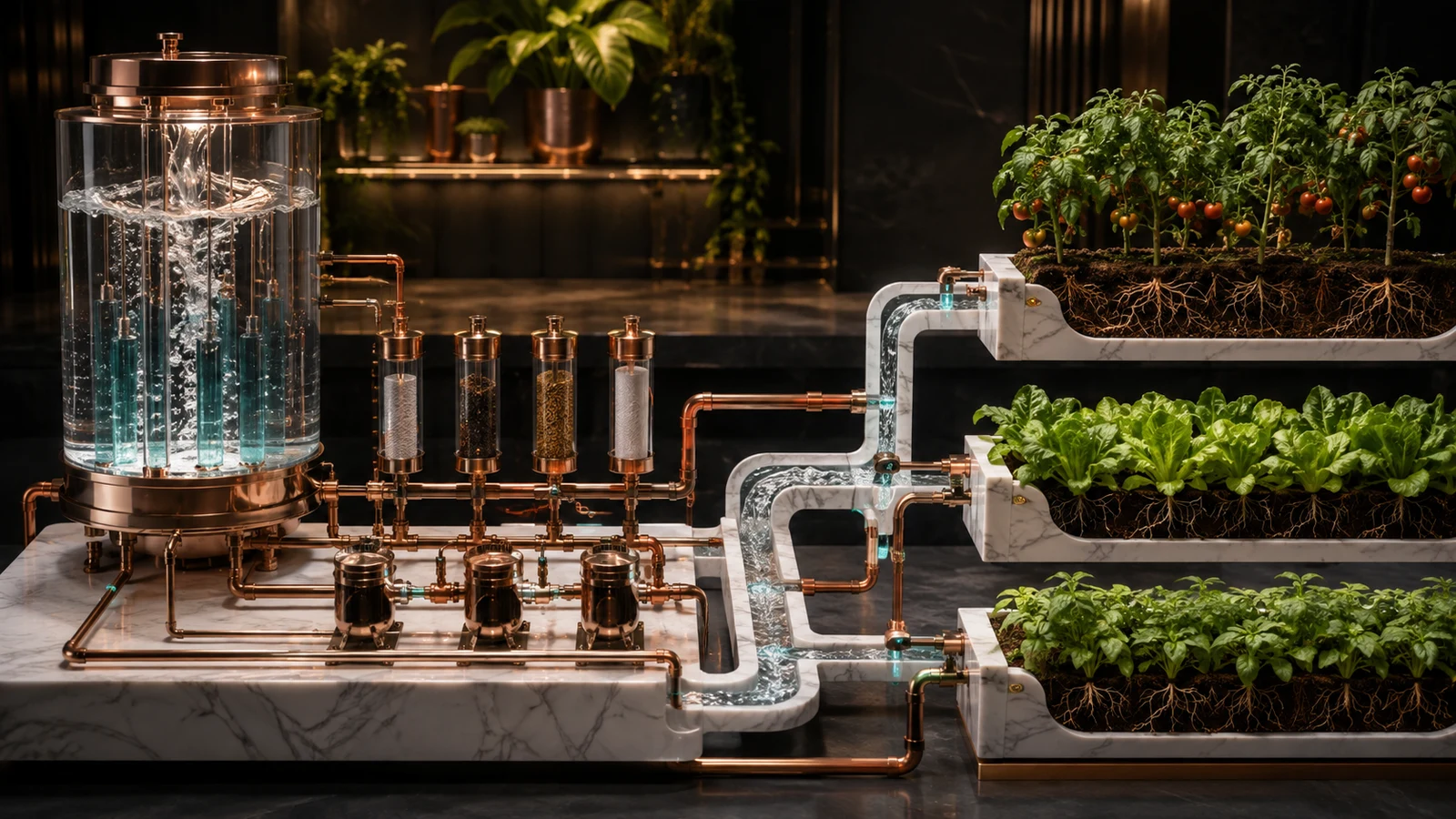
The operating challenge
The recipe is only one part of what the roots receive.
A greenhouse controller may execute every scheduled irrigation and still leave part of a crop too wet, too dry, or exposed to an inappropriate nutrient solution. Source-water quality, mixing, emitter delivery, crop stage, root-zone conditions, temperature, and drainage all influence the result. Teams need to see the difference between a command, a delivered dose, and a verified crop response.
One sensor is not the crop
An EC measurement indicates overall dissolved-salt concentration, not the amount of each nutrient. A pH change affects availability but does not identify a specific deficiency.
Delivery varies by zone
A valve may open while a filter, pressure problem, blocked emitter, or faulty flow meter prevents the intended volume from reaching a bed.
The crop changes with time
Water demand and nutrient management vary with growth stage, light, temperature, and cultivation method. A fixed schedule or a rule trained on another crop can be misleading.
Why modernize: Help growers intervene earlier with clearer evidence, use water and inputs more deliberately, and document why a recipe was changed. Automation is valuable only when the measurements and safeguards are trustworthy.
Illustrative operating example
A leafy-greens zone shows rising return EC.
This controlled-environment crop scenario is illustrative. It is not a claim about a completed customer installation, a nutrient diagnosis, or a measured yield or water-saving result.
Imagine a recirculating leafy-greens system where return-solution EC rises through a warm afternoon. The usual response might be to dilute the reservoir. But the source-water EC has also changed, a dosing-pump service visit occurred that morning, and one channel reports weaker flow. The return sample may be affected by evaporation, uptake, mixing, sensor drift, or local delivery problems. The grower should not change the nutrient recipe solely because one number crossed a limit.
- Locate the reading.Identify whether the sample comes from source water, mixed supply, return, or a specific bed. Confirm units, temperature compensation, calibration, and the crop batch it represents.
- Reconstruct delivery.Align mixing and dosing commands with tank level, pump and valve state, flow, irrigation duration, and return volume. A command is not proof of delivered solution.
- Check comparable crop context.Review cultivar, growth stage, recent temperature and light, root appearance, water use, and prior measurements. Look for a localized channel issue before treating the whole reservoir.
- Ask for a qualified decision.When supply and return behavior disagree or sensors conflict, the system creates a review record. The grower checks samples or equipment and approves any recipe, flush, or scheduling change.
- Record the result.Capture the confirmed cause, action, and later crop and solution response. If the signal was a drifting probe, correct the measurement process rather than crediting a recipe change.
What the grower would see
Leafy Greens Zone B: return-solution review
Existing pump protections and approved dosing limits remain in force. Analytics have not changed the nutrient recipe.
- Condition
- Return EC trend differs from comparable crop-stage windows.
- Context
- Source and supply EC, pH, tank level, irrigation and flow, temperature, light, and recent service are linked.
- Uncertainty
- One low-flow channel and probe calibration status require confirmation before interpretation.
- Decision
- The grower or qualified technician samples and inspects, then authorizes a bounded correction if warranted.
Other high-priority situations
Similar symptoms can require different action.
A bed is dry despite scheduled watering
Compare valve command, actual flow, line pressure, substrate water content where measured, and the affected bed. A blocked filter or emitter needs maintenance; increasing every zone's schedule could overwater healthy areas.
Useful report: commanded and delivered volume, affected zone, pressure, moisture trend, and verified repair.
Drainage rises after a recipe change
Review crop stage, irrigation frequency, input and return volume, EC, and source-water quality. Excess drainage may be a scheduling or equipment issue, while low drainage can also be intentional for a given crop strategy. The grower defines the acceptable operating window.
Useful report: water balance, crop and recipe version, runoff context, and crop observation.
What a modernization would connect
Trace water and nutrient solution from source to root zone.
Start with a physically accurate zone map and the existing controller. Show what each probe and meter really measures, where water is mixed and recirculated, and which crop batch it serves. An analytical layer can remain read-only until the team has validated delivery, data quality, and agronomic decisions.
Required operating evidence
- Crop, cultivar, batch, zone, bed, stage, and approved recipe version
- Source-water quality and mixed-supply EC, pH, temperature, and tank level
- Pump, valve, dosing, pressure, and actual flow or volume where available
- Return or drainage volume and quality, with sample location
- Root-zone moisture or substrate measures where relevant
- Light, temperature, humidity, service, calibration, and grower observations
EC is a useful aggregate signal, not a substitute for individual nutrient analysis or crop inspection.
Connected technical layers
- Existing irrigation and dosing controllers with local interlocks
- Validated sensors and lab or handheld checks as appropriate
- Read-only collection with explicit point, zone, and clock identity
- Crop and recipe records plus grower review workflow
Loss of the analytical service cannot become loss of the approved irrigation program or essential alarms.
A controller setpoint, a measured solution, and plant uptake are different facts. Keep each labeled and retain the evidence behind any proposed adjustment.
Where automation and AI fit
Automate dependable checks; treat optimization as a tested hypothesis.
Deterministic automation
Flag stale or implausible probes, a valve open without expected flow, dosing outside an approved limit, a tank level that conflicts with recorded delivery, or a mismatch between scheduled and actual irrigation. Escalate critical equipment conditions through existing local rules.
Analytical models
With enough crop-stage and zone history, compare water use and solution behavior under similar environmental load. Test any model against simple grower-defined rules and real crop observations before using it to propose new schedules.
Evidence-linked AI assistance
An approved assistant can prepare a zone comparison, identify conflicting data, and summarize prior grower decisions. It must not infer a specific nutrient deficiency from EC alone or present a predicted yield as a fact.
Human and crop authority
Growers and qualified technicians own sampling, nutrient composition, irrigation limits, equipment work, and release of any revised recipe. Existing dosing limits and fail-safe controls remain independent.
How we examine a proposed solution
Specialized AI advisors support review, not crop control.
These Adaptiv Stratum AI advisory roles are bounded research and design-review resources. They are not growers or a claim that named agents operate a customer's fertigation equipment.
Demeter
Challenges crop-stage, root-zone, and input assumptions against available grower evidence.
Argus
Checks sensor identity, sampling location, calibration, and continuity.
Hephaestus
Reviews pumps, valves, dosing limits, and controller boundaries.
Pythia
Tests whether zone comparisons add value beyond transparent thresholds.
Clio
Checks trial design, crop comparability, and unsupported yield or resource claims.
Themis
Challenges recipe authority, traceability, and sign-off.
What becomes visible
A useful report connects input, delivery, response, and grower decision.
The zone view helps with today's problem. The crop-batch view shows whether an approved strategy remains useful across time. Both should expose sampling location, data quality, cultivar, stage, and exceptions rather than hiding them in a single health score.
Zone and event record
- Crop, batch, zone, approved recipe, and operating window
- Source, supply, return, and substrate measures with units and probe status
- Commanded versus measured irrigation and dosing
- Flow, pressure, tank level, and relevant environmental context
- Uncertainty, grower finding, action, and later observation
Crop-batch measures
- Water delivered and drainage by zone and growth stage
- Valid-data coverage and probe calibration failures
- Time spent outside grower-approved EC and pH windows
- Delivery faults, response time, and repeated issues
- Input use, crop quality, and harvest outcome where recorded
- False alarms and changes to recipe or schedule
A smaller water volume is not an improvement if crop quality or root health deteriorates. EC and pH trends should prompt appropriate sampling and interpretation, not automatic conclusions about individual nutrients.
Operating safeguards
Keep crop protection local and uncertainty visible.
- Document sample location, calibration, units, and sensor replacement
- Analyze source water and account for its contribution to EC and pH
- Preserve controller interlocks, pump protections, and dosing limits
- Do not infer specific nutrient concentrations from EC alone
- Separate valve command from measured delivery
- Make recirculation, drain, cleaning, and maintenance modes explicit
- Require grower approval for recipe and schedule changes
- Record crop-stage differences and failed or rejected recommendations
A practical first phase
Choose one crop, one zone, and one repeatable question.
- Set the agronomic boundary.Identify crop, stage, approved recipe, response owners, existing alarms, and the decisions the grower will consider.
- Map and check the measurements.Confirm source water, mixing, actual flow, probe calibration, and where each sample represents the crop.
- Observe a full operating pattern.Collect comparable irrigation and environmental windows; log cleaning, maintenance, and crop-stage transitions.
- Review a real discrepancy.Have the grower compare the system explanation with handheld or lab checks and crop observation. Keep the new analysis advisory.
- Judge the result.Measure whether the record improved response and input understanding without hurting crop quality. Expand only after the grower accepts the evidence and controls.
Begin with one grower decision
Where is your delivery or root-zone picture incomplete?
A crop, one zone, the current recipe, and a recurring discrepancy are enough to frame a useful first review.
Evidence and further reading
Treat measurements as evidence, not a recipe by themselves.
These university and extension resources inform the method. The crop scenario above is illustrative, not an Adaptiv Stratum customer case study.
- UMass Amherst Extension: Soluble salts and EC explains what EC reflects and why crop media should be tested rather than interpreted from a single number.
- UMass Amherst Extension: Water analysis explains source-water testing and its role in fertilizer and irrigation choices.
- University of Arizona Controlled Environment Agriculture Center: Vertical farm describes monitoring nutrient solution and resource use in a research environment.