

Environment · Equipment · Crop Cycle
Every crop cycle produces operating evidence. Make the next decision from it.
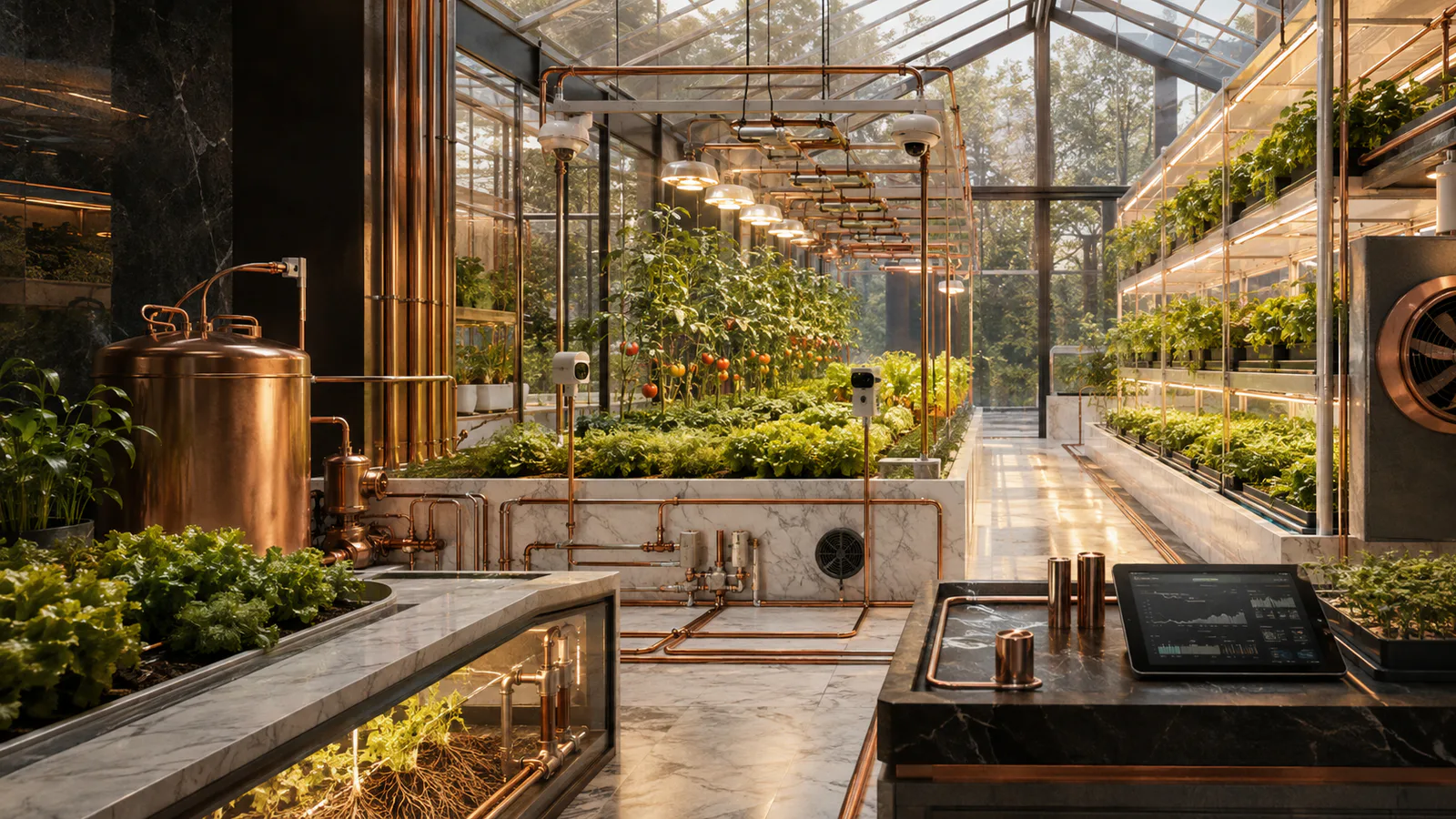
Controlled-environment agriculture becomes more understandable when crop identity, environmental history, water and nutrient conditions, equipment behavior, interventions, and harvest outcomes can be examined together.
Operating purpose
Why the business should care.
Every crop cycle combines biology, environment, water, nutrients, equipment, labor, and timing. When those records remain separate or exist only as scheduled checks, the operation cannot confidently explain why zones, batches, or cycles performed differently.
A controlled-environment data system creates useful history around what plants and equipment experienced. It supports earlier response and better comparison while keeping cultivation judgment, food safety, environmental controls, and equipment authority with the appropriate people and systems.
Useful capability
What can become visible or easier to coordinate.
Environmental conditions
Relate air temperature, humidity, vapor pressure deficit, CO₂, light, photoperiod, airflow, and equipment state to zones and crop stages.
Root zone and water
Connect water temperature, pH, conductivity, dissolved oxygen, moisture, flow, pressure, tank level, dosing, and leak conditions.
Equipment performance
Observe pumps, fans, valves, compressors, lighting, HVAC, chillers, and water systems alongside the environment they support.
Crop and production history
Link crop stage, tasks, images, observations, harvest, loss, inputs, labor, energy, water, and yield under stable batch or zone identity.
High-level approach
How the work is structured.
Define the crop and operating question
Identify the variety, stage, zone, outcome, expected range, decision horizon, and cultivation responsibility.
Instrument the environment and equipment
Choose measurements with appropriate location, calibration, sampling, redundancy, and maintenance for the conditions.
Preserve crop-stage context
Relate time-series conditions to batches, zones, recipes, tasks, interventions, and outcome rather than treating readings as anonymous data.
Control through approved systems
Use local environmental controllers, PLCs, or bounded application logic for permitted action with safe states and manual authority.
Analyze and improve carefully
Compare cycles and zones, investigate anomalies, test hypotheses, and change one controlled element with measurable acceptance conditions.
Operating safeguards
How the business keeps control.
- Cultivation and equipment setpoints remain governed by approved recipes, ranges, controllers, and responsible operators.
- Sensor placement, calibration, contamination, cleaning, drift, and environmental suitability are part of measurement quality.
- Network or cloud loss does not remove essential local environmental control.
- Automated dosing, irrigation, lighting, HVAC, and CO₂ actions require explicit limits, interlocks, and confirmed state.
- Computer vision and machine learning findings are treated as observations or recommendations until appropriately reviewed.
Business evidence
Measurements used to support decisions.
Each measure is tied to a stable definition, source record, baseline, and named decision.
Engineering examples
How the connected operation works.
Environmental intelligence by growing zone
- Operating problem
- Nominally similar zones produce inconsistent crop performance.
- Information used
- Temperature, humidity, CO₂, PAR, irrigation flow, pH, EC, lighting power, crop stage, images, interventions, and yield.
- Working approach
- Zone and crop-cycle identities align environmental and equipment history with observations and harvest outcomes; analysis highlights repeatable differences for controlled review.
- Business value
- A stronger basis for explaining variation and planning targeted experiments instead of changing the entire operation at once.
Irrigation and pump anomaly
- Operating problem
- A scheduled irrigation event appears complete, but one zone receives declining flow.
- Information used
- Command state, valve position, pressure, flow, pump current, reservoir level, zone identity, and expected delivery.
- Working approach
- Local controls retain irrigation authority while telemetry compares commanded and measured delivery and creates an exception when the relationship diverges.
- Business value
- Earlier detection of a blocked line, valve issue, leak, or pump degradation before crop stress becomes the first signal.
Begin with the operating condition
Discuss what the operation needs to measure, connect, or control.
We can help establish the requirement, available evidence, practical architecture, and responsible next step.
Start a private conversation