

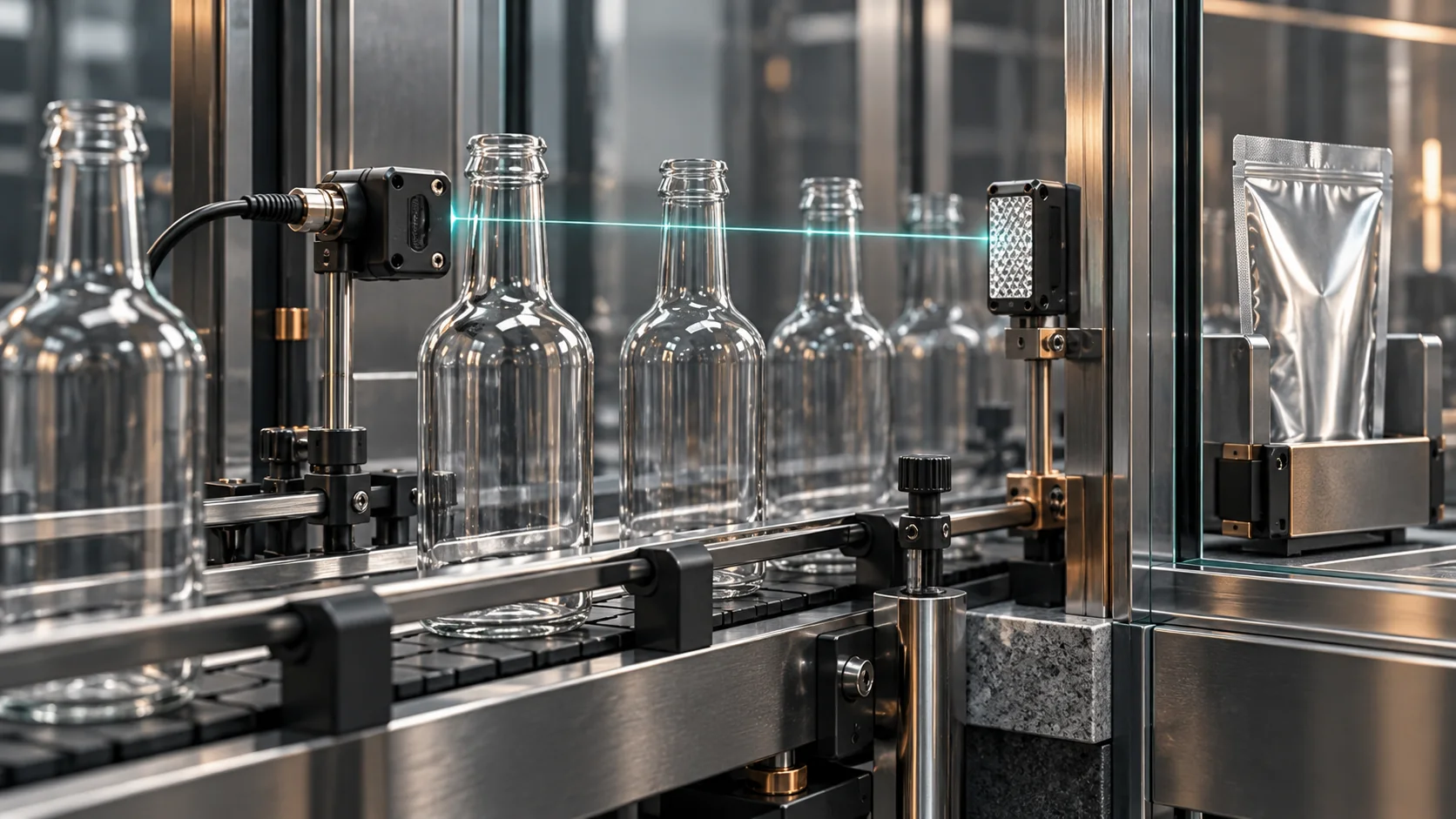
The line counts opaque packages correctly and misses some clear bottles. A sensitivity adjustment helps one product but creates double detections on another. The counter is not necessarily an AI problem. It may be a conventional optical presence-detection application that has never been tested against the full product range.
Commission the detector using representative samples, backgrounds, positions, speeds, and contamination conditions. Compare the resulting events with an appropriate reference count. The decision is whether the chosen arrangement reliably supports this production task, not whether the product category is described as suitable for transparent objects.
Separate presence detection from visual inspection
A photoelectric presence sensor detects an optical condition and produces an event or state. It does not necessarily inspect a bottle for defects, identify its contents, or classify product quality. Keep the task narrow before deciding that a camera or a machine-learning model is needed.
Clear and reflective objects can create demanding optical conditions. Banner Engineering's clear-object sensor documentation illustrates a purpose-designed conventional approach. It is evidence of a specific manufacturer's offering, not an endorsement or proof that the device fits every bottle, film, speed, or installation.
Record the exact sensing arrangement and configuration, including reflector where applicable, mounting, alignment, distance, and output interpretation. A candidate may detect the object but produce an event sequence the counting software handles incorrectly. The entire path from object passage to recorded count deserves a defined test.
Include the difficult sample variants
List clear and tinted bottles, different shapes, labels, caps, reflective packages, empty and filled states where relevant, and the backgrounds the detector sees. A single ideal sample cannot establish performance across a changing production mix.
Test the permitted operating conditions that matter to the task, such as product spacing, position variation, line state, and representative contamination. Follow the manufacturer's instructions and site safety arrangements. Do not reach into moving equipment or defeat guarding to present a sample.
Agree what constitutes a miss, an extra detection, and a valid count before examining results. A total of 100 can conceal two misses and two double counts. Retaining event-level comparison evidence helps reveal those errors rather than celebrating a matching total.
- Define the eventSpecify the presence task and counter interpretation.
- Select difficult samplesInclude clear, reflective, and varying product conditions.
- Compare each passageRecord misses and extra events against the reference.
- Accept the setState tested variants, limits, and retest triggers.
Follow a clear-bottle acceptance test
In a hypothetical packaging line trial, the commissioning register is the source of truth for test conditions and acceptance. The line counter retains the event records. A suitable reference method identifies each intended passage within a defined window.
For an illustrative run of 100 passages, the detector misses three and produces two additional events elsewhere. It records 99 events: 100 minus three plus two. Reporting a one-percent total difference hides the fact that five event discrepancies need investigation. A row for each discrepancy makes sample and position patterns visible.
The engineer compares those events with the specific bottle variants and the installed geometry. A candidate adjustment is documented and tested against all relevant sample groups, not just the bottle that originally failed. If another variant becomes worse, the acceptance matrix records the tradeoff rather than overwriting the old result.
The technical owner decides whether the arrangement meets the intended production requirement or needs a different detector, mounting, or counting approach. An untested new bottle design remains outside the accepted sample set until reviewed. The process does not automatically approve it because it shares a product family name.
Build a presence detection matrix
Useful columns are:
- Sample: product variant, material, shape, label, contents state, and reference identity.
- Condition: background, position, spacing, line state, and relevant environmental condition.
- Configuration: detector, reflector if used, settings, mounting, and counter interpretation.
- Reference: expected passages and the method used to establish them.
- Outcome: matched events, misses, additional events, uncertain comparisons, and evidence references.
- Decision: acceptance requirement, reviewer, limitations, and triggers for retesting.
Define the counting window and reset behavior as part of the test. An object already inside the sensing zone at the start, or still present when the window ends, can create an apparent mismatch between passage and event counts. Keep those boundary cases identifiable rather than changing the reference total afterward to match the detector.
Keep detection and personnel safety separate. A general-purpose presence detector must not be repurposed as a protective device for people. Any safety function requires its own properly qualified selection, design, and validation process.
Choose simpler sensing when it answers the question
Conventional photoelectric sensing may be sufficient for a well-defined presence task. Software rules can reconcile events and detect missing test conditions. AI can summarize a commissioning matrix or identify sample variants that have not been tested; it should not manufacture successful results or replace the engineer's acceptance decision.
Start with the transparent or reflective product that generates complaints and include the neighboring variants that share the line. Measure event-level misses and extras, not only aggregate count agreement. A useful commissioning result explains which products and conditions were accepted, what changes require retesting, and where the business should still treat the count as uncertain. That clarity prevents a small detector problem from spreading into unreliable inventory and production reporting.
Sources & further reading
Primary references checked October 19, 2026. Examples are illustrative, not reported client outcomes.
- Banner Engineering's clear-object sensor documentationPrimary background for the linked discussion. Use the actual application, current product documents, and qualified review for operating or acceptance decisions.