

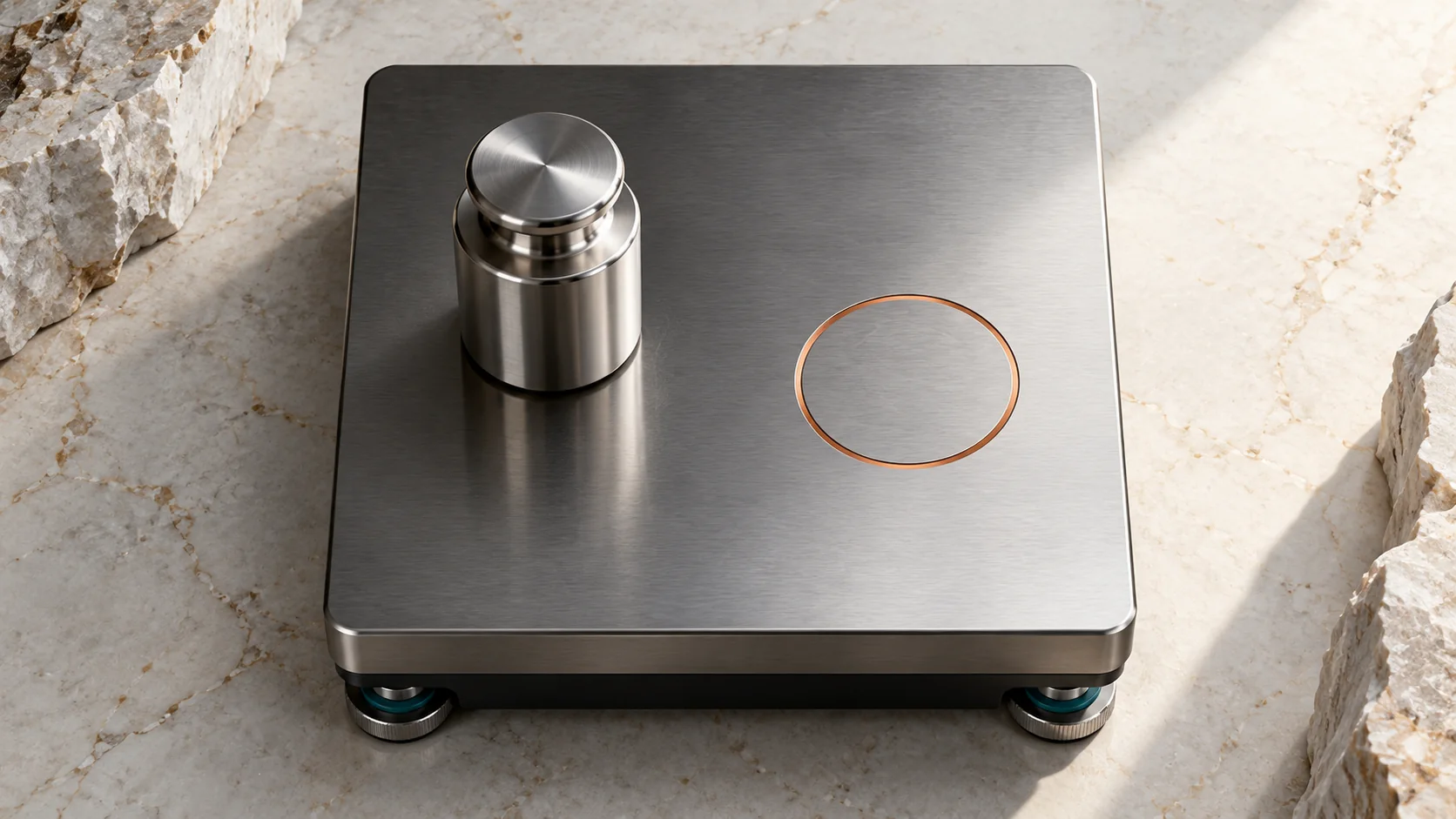
An operator weighs the same container twice and gets different results. Another employee moves it slightly and sees a third value. The dashboard can calculate precise totals from those readings, but the business has not yet established whether the weighing station is repeatable under normal use.
Test the station with an appropriate reference and a defined loading method before adjusting the production recipe or blaming staff. Separate repeated measurements under the same conditions from position effects and other changes. The aim is to understand suitability for the actual decision, not to turn a short internal test into a calibration certificate or legal-for-trade approval.
Distinguish repeatability from other errors
Repeatability concerns the variation when a measurement is repeated under specified conditions. Off-center loading asks another question: whether placing a load differently affects the indication. An instrument can repeat consistently at one position and still produce a different result elsewhere.
Mettler Toledo's balance-testing procedures distinguish tests including repeatability and eccentricity. Use the principles with equipment-appropriate instructions and competent review; a laboratory balance procedure is not automatically the commissioning specification for a large industrial platform.
Also distinguish consistent readings from correct readings. A stable offset can be highly repeatable. The reference, its suitability, the loading procedure, and the intended process tolerance matter to the acceptance decision. Showing more decimal places cannot compensate for an unsuitable measurement arrangement.
Record the station as operators use it
Document platform, load cells or balance, indicator, software scaling, container, tare method, support arrangement, and relevant environment. Nearby contact, hoses, vibration, drafts, temperature, and loading practice can be investigation questions depending on the installation. They are not causes established simply because they appear on a checklist.
Choose safe, approved test loads and methods. Follow capacity, handling, and manufacturer requirements. Do not add arbitrary weights, exceed the rated range, or attempt adjustments without authorization. If testing requires service intervention, use the appropriate qualified technician.
Keep zero, tare, gross, and net values distinct where the process depends on them. An inconsistent tare can make equal contents appear different. A worksheet that records only the final displayed value may hide that difference and send the investigation toward the wrong component.
- Define the purposeSet the process requirement and approved reference method.
- Record the stationCapture tare, support, configuration, and environment.
- Separate the testsRetain individual repeated and position observations.
- Review suitabilityAuthorize corrections and retest within a stated scope.
Compare repeated and off-center loading
In a hypothetical production station, the quality lead defines an approved check using a suitable reference. The weighing-test register is the source of truth for observations, linked to the instrument configuration and reference information. The team records the same loading method for the first series.
Three illustrative readings are 10.00, 10.02, and 9.99 kilograms. Their observed range is 10.02 minus 9.99, or 0.03 kilograms. That simple range is not the reference's uncertainty, the station's full accuracy, or a pass decision. Acceptance requires the defined method and the tolerance relevant to the process.
A separate position test uses the approved arrangement at documented locations. A difference appears near one corner, so the technician investigates the installation and loading effects rather than combining all results and calling the larger spread repeatability. The team preserves the distinction between the two tests.
If corrective work is authorized, the relevant checks are repeated afterward. Failed or interrupted observations remain in the history. The quality lead decides whether the station is suitable for the intended use and what should happen to measurements made during an unresolved period. Software does not retrospectively correct production quantities from an unverified assumption.
Build a weighing test matrix
The matrix should record:
- Purpose: production decision, operating range, acceptance requirement, and responsible reviewer.
- Station: equipment identity, configuration, container and tare state, environment, and service status.
- Reference: approved load, identification, relevant evidence, and limitations.
- Method: repeated or position test, loading sequence, locations, settling rule, and safety procedure.
- Results: individual observations with units, calculated summaries, interruptions, and deviations.
- Disposition: findings, authorized action, retest, and acceptance scope.
Decide how routine checks will detect a meaningful change after acceptance. Record the approved check, its responsible person, and what happens when the result is outside the agreed limit. Do not quietly continue using the station because the last formal test passed; preserve the new exception and obtain the required operational review.
For commercial weighing, additional requirements may apply. NIST Handbook 44's 2026 publication describes requirements adopted by many U.S. authorities. Applicability and local acceptance need the relevant authority and qualified review. An internal matrix cannot confer legal-for-trade status.
Use automation after the measurement question is clear
Ordinary software can retain individual readings, calculate defined statistics, and flag incomplete test conditions. AI can summarize the pattern or identify that position and tare were mixed across observations. It should not issue a calibration certificate or declare the station acceptable from a small numerical spread.
Start with the load and handling pattern that produce the operational complaint. A useful result is a reproducible explanation and a bounded acceptance decision, even if more testing is needed. That foundation makes later inventory, batching, and reporting automation worth trusting rather than merely faster at distributing uncertain weights.
Sources & further reading
Primary references checked October 19, 2026. Examples are illustrative, not reported client outcomes.
- Mettler Toledo's balance-testing proceduresPrimary background for the linked discussion. Use the actual application, current product documents, and qualified review for operating or acceptance decisions.
- NIST Handbook 44's 2026 publicationPrimary background for the linked discussion. Use the actual application, current product documents, and qualified review for operating or acceptance decisions.