

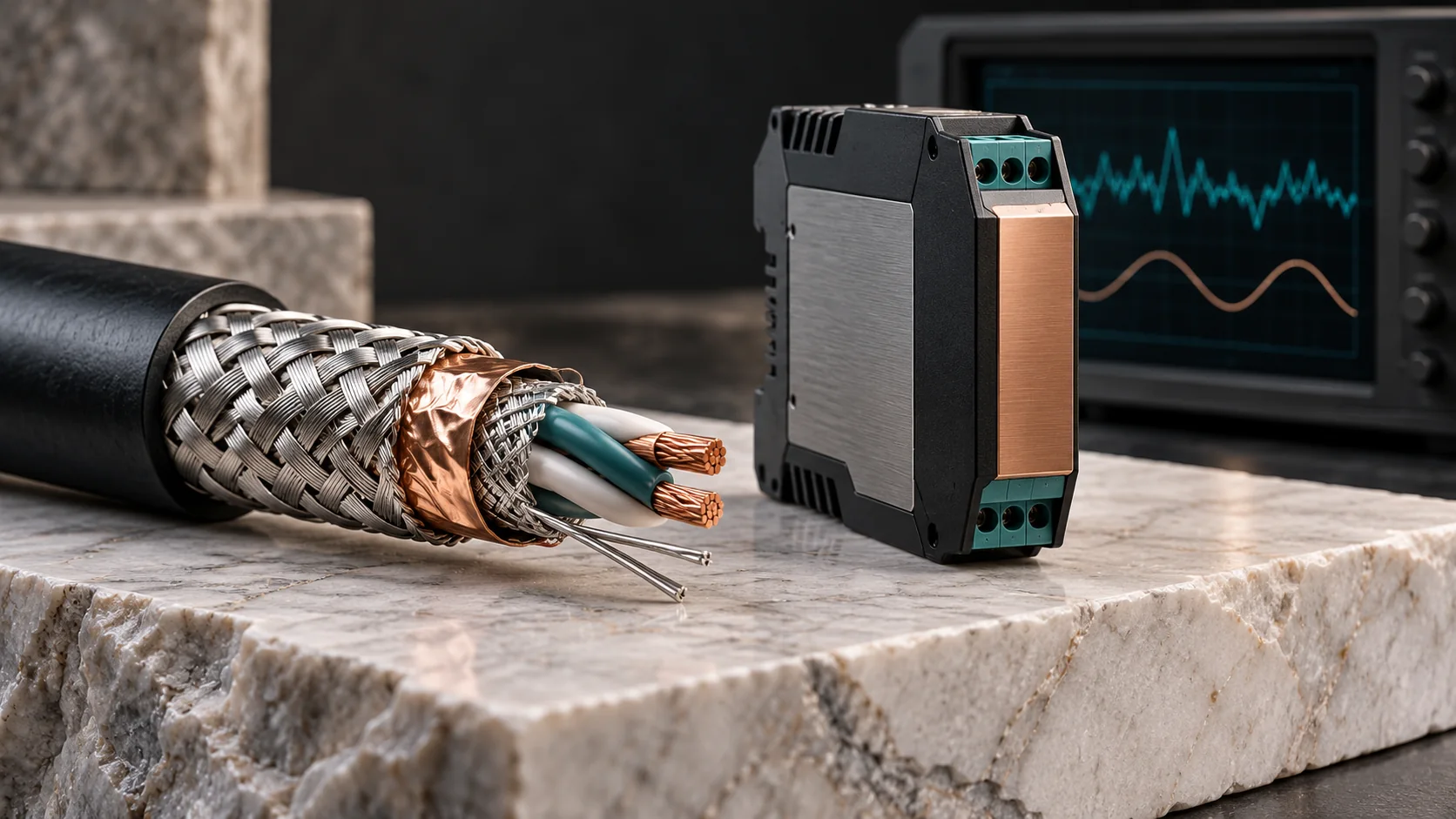
An analog reading jumps when nearby equipment starts. Operators see the trend and adjust the process, but the material or pressure may not have changed at all. The measurement chain could be responding to electrical conditions rather than the quantity the business intends to monitor.
Investigate the signal path before changing process settings. A qualified technician should compare the symptom timing, independent process evidence, wiring and reference arrangements, acquisition configuration, and approved test findings. This is not a do-it-yourself wiring guide. It is a record structure that helps distinguish a real process event from an unresolved measurement problem.
Map the complete signal chain
Identify the sensing element, transmitter, power supply, cable route, signal conditioner or isolator, acquisition input, scaling, and displayed value. Keep the actual drawing and configuration references. A sensor replacement may leave the same cable, input arrangement, and display error untouched.
Describe the symptom precisely. A brief spike, a sustained offset, intermittent dropout, and a clipped reading suggest different investigation questions. Record when the symptom occurs, how long it lasts, and what other equipment or operating state coincides with it.
NI's guidance on diagnosing analog measurement noise discusses several interference and measurement considerations. Its technical background helps a qualified investigation; it is not a universal instruction to move a shield connection or alter a live installation.
Correlation identifies a test question
If a reading changes when a motor starts, preserve both timestamps and their uncertainty. That coincidence may indicate interference, a genuine process response, a shared power issue, or another dependency. Do not name the motor as the proven cause from timing alone.
Compare an appropriate independent reference where the site has a safe, valid method. State the reference's own limitations and whether it observes the same quantity at the same location and time. Two different process points need not agree even when both instruments work correctly.
Also inspect the data path. A displayed jump might arise from scaling, input configuration, sampling, communication, or a software transformation. Keep raw and processed records where available. A smoothing filter can make a graph look calmer while hiding the evidence needed to find the underlying issue.
- Map the chainRecord the sensor, power, wiring, acquisition, and scaling.
- Describe the symptomPreserve timing and independent process evidence.
- Test through authorityUse a qualified owner and approved safe method.
- Retest the correctionKeep configuration history and the acceptance limits.
Follow one recurring startup disturbance
In a hypothetical plant, a pressure trend changes around a nearby equipment startup. The measurement-investigation register is the source of truth for the test history, linked to the instrument drawings and historian. The production team retains the existing approved operating procedure while the measurement concern is reviewed.
The qualified technician documents the timing and confirms the permitted test plan, including safe access and isolation requirements. An appropriate reference does not show the same pattern during a recorded comparison. That finding supports further investigation of the measurement chain, but does not on its own identify the failing component.
The technician records approved checks of the signal path and configuration. A proposed corrective action goes through the site's engineering process. Protective earth, equipment safeguards, and required isolation are not removed merely to see whether the trend improves. NI's isolation discussion provides relevant concepts, but the actual design must meet the installation's requirements.
After authorized work, the team repeats the documented observation under comparable conditions. If the symptom disappears in that test window, the record states the tested scope and any remaining uncertainty. It does not claim that all noise has been eliminated forever. If the issue remains, the investigation stays open rather than substituting a larger averaging filter and marking it solved.
Build an analog signal investigation sheet
The useful sheet includes:
- Measurement: intended quantity, process point, units, operating range, and consequence of a wrong reading.
- Chain: sensor, transmitter, power, wiring references, conditioning, acquisition, scaling, and software versions.
- Symptom: timing, duration, raw evidence, coincident events, and missing information.
- Test: qualified owner, approved method, safe-work reference, comparison evidence, and limitations.
- Finding: what the test supports, what it rules out, and competing explanations still open.
- Correction: authorized change, configuration record, retest, and operational acceptance.
Separate a temporary monitoring workaround from a verified fix. If operators must treat the reading cautiously during investigation, the responsible person should define that limitation through the established operating process. The reporting system cannot invent a substitute safety function.
Let automation preserve the evidence
Conventional tools can align events, maintain configuration versions, and compare before-and-after records. AI can summarize an investigation and identify an omitted reference or unexplained scaling change. It should not diagnose grounding arrangements from an incomplete description or issue instructions for energized testing.
Start with one recurring symptom and a competent technical owner. The business value is avoiding process decisions based on an untrusted signal while creating a reproducible path to correction. Measure repeat disturbances under the tested conditions and unresolved investigation age, not the visual smoothness of a dashboard that may simply be hiding the problem.
Sources & further reading
Primary references checked October 19, 2026. Examples are illustrative, not reported client outcomes.
- NI's guidance on diagnosing analog measurement noisePrimary background for the linked discussion. Use the actual application, current product documents, and qualified review for operating or acceptance decisions.
- NI's isolation discussionPrimary background for the linked discussion. Use the actual application, current product documents, and qualified review for operating or acceptance decisions.