
The Cancellation Problem That Was Bigger Than It Looked
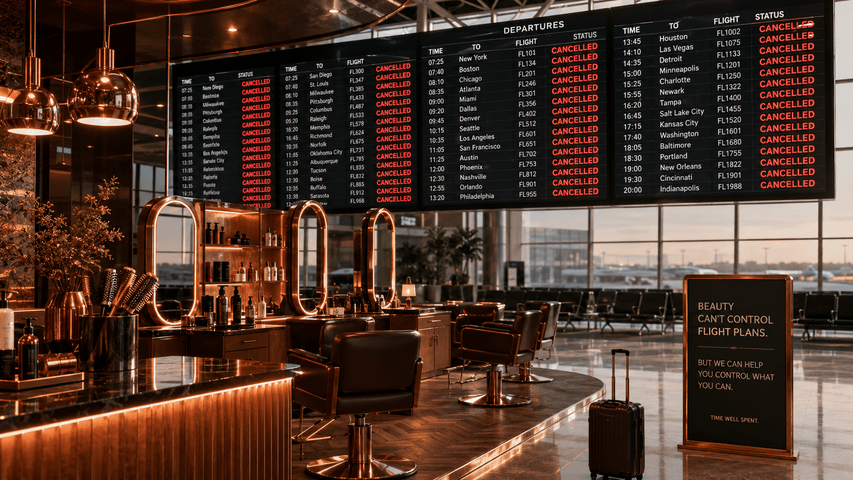
Standard reports showed canceled appointments as a count. They did not clearly show how much expected revenue disappeared, which slots were recovered, which slots stayed empty, or which cancellation patterns were creating the greatest financial exposure.
The issue was not simply that appointments were canceled. The issue was that many canceled appointments were never replaced.
What Adaptiv Stratum examined
Adaptiv Stratum reviewed canceled appointments, service values, cancellation timing, replacement bookings, waitlist activity, client history, and provider schedules.
The objective was to separate ordinary cancellation noise from unrecovered appointment value.
- Canceled appointments that were never replaced
- Late cancellations with low resale probability
- Missed waitlist recovery opportunities
- Revenue exposure hidden behind ordinary cancellation counts
The hidden issue
A canceled appointment is not automatically a lost appointment. If the slot is refilled quickly, the business may recover most or all of the revenue. If the slot remains empty, the expected revenue disappears.
In this composite scenario, the salon had a meaningful number of canceled appointments that were never replaced. The business could see that the appointments were canceled, but it was not measuring the difference between recovered cancellations and unrecovered cancellations.
This created ghost revenue: money that was expected, scheduled, and visible in the appointment book, but never converted into completed service revenue.
The owner did not need a larger cancellation count. The owner needed to know which cancellations actually damaged the business.
Example findings
In this composite scenario, Adaptiv Stratum identified several recurring patterns:
- Some canceled appointments were removed too late to be realistically resold.
- Several high-value services had a lower replacement rate than shorter, easier-to-fill appointments.
- Some providers had more unrecovered cancellation value than others, even when their cancellation counts looked similar.
- The salon had waitlist demand, but not every canceled slot triggered timely outreach.
- Cancellation reports showed appointment loss, but not the dollar value of unrecovered calendar inventory.
A cancellation count does not show the full financial problem. The more useful question is how much canceled appointment value was never recovered.
Illustrative financial model
The financial impact depends on the salon’s average service price, cancellation volume, cancellation timing, replacement rate, and ability to refill open appointment slots.
| Cancellation issue | Illustrative impact |
|---|---|
| Average canceled appointment value | $135 |
| Average unrecovered cancellations per month | 18 |
| Estimated unrecovered value per month | $2,430 |
| Estimated unrecovered value per quarter | $7,290 |
| Estimated annualized ghost revenue exposure | $29,160 |
This figure is not the same as guaranteed recoverable revenue. Some cancellations will remain difficult to replace. The purpose of the analysis is to identify where recovery is realistic, where policies are too weak, and where follow-up needs to happen faster.
What changed operationally
Once unrecovered cancellation value was measured, the salon could make more precise operating decisions.
- Late-cancel patterns could be separated from early cancellations.
- High-value canceled slots could trigger faster waitlist outreach.
- Repeat late-cancel clients could be reviewed for stronger confirmation or deposit rules.
- Cancellation recovery could be measured by dollars recovered, not just appointments refilled.
- Provider schedules could be reviewed for cancellation exposure during peak demand windows.
The salon did not need to treat every cancellation the same way. It needed to distinguish low-risk cancellations from cancellations that repeatedly destroyed revenue.
The operating lesson
A cancellation is not just a blank space on the calendar. It is inventory that either gets recovered or expires.
When canceled appointments are not measured by timing, service value, replacement rate, and client behavior, the business may underestimate the real cost. A salon can appear busy while still losing thousands of dollars through appointment slots that were once booked but never completed.
Adaptiv Stratum helps identify whether the salon has a cancellation problem, a recovery problem, a waitlist problem, or a policy enforcement problem.
Find out what your cancellations may be costing
Adaptiv Stratum reviews appointment, cancellation, client, and service data to identify ghost revenue, unrecovered appointment value, and operational patterns that standard reports often leave unanswered.
Request a Private Consultation