One clear place to begin
The tenant does not need to search a contractor list or determine which person is on call. They describe the issue and location in ordinary language.


Service Businesses · Property Management
When configured and validated for your organization, tenants can report service problems through a dedicated property-management line. The workflow identifies the request, applies the property’s approved rules and attempts an eligible provider connection or the approved next step.
Setup comes first. A dedicated property-management line, organization-specific configuration and testing are required before live service. An available workspace or a successful login does not activate phone service. Review what must be agreed before launch →

Why it matters
Tenants may not know whom to call, approved vendors may differ by property, and after-hours requests often arrive without the information needed to act. Every unclear handoff adds delay for the tenant and avoidable coordination work for management.
The tenant does not need to search a contractor list or determine which person is on call. They describe the issue and location in ordinary language.
Properties, services, hours, providers, priorities, and escalation paths are configured by the organization, not improvised during the conversation.
Request flow

A dedicated number provides one reliable starting point.
Only the facts needed for the approved response are gathered.
Service, property, hours, availability, and escalation requirements determine eligibility.
The approved provider receives context and can accept the connection.
Accepted, declined, missed, fallback, or unresolved results remain visible.
Configuration
The workspace turns agreed operating policy into maintainable configuration. Routine changes do not require rewriting the caller conversation; they must still pass the applicable review, publication and connection checks. Validate normal hours, after-hours responsibility and failed attempts before using the workflow for live requests.
Management supplies and approves properties, service rules, provider choices, hours and escalation contacts, and names the person responsible for unresolved requests. Adaptiv Stratum configures and maintains only the work agreed for the engagement; ongoing support and changes must be scoped. Approved providers decide whether to accept the offered connection. Management retains service follow-up when a request remains unresolved.
A requested change to a provider, schedule or escalation contact is not an automatic live release. The change must pass the agreed review and validation before it is used; workspace configuration does not independently authorize a connection.
Normal and after hours

Eligible providers and management contacts follow the approved service, property, schedule, and priority configuration. Routine questions can be handled without interrupting the team.
The system gathers the approved minimum information, uses the on-call destination when eligible, and avoids promising dispatch or arrival until someone accepts responsibility.
A decline, timeout or missed attempt follows the configured failure policy. Use an alternate only when it is explicitly approved and eligible; otherwise use the agreed return or message path. The design should end clearly rather than retry indefinitely.
Provider acceptance
The provider can receive a concise summary, accept the request, and then connect with the tenant. A decline, timeout, missed call, or voicemail is recorded as a different outcome so management can see what actually happened.
Isolated workspace
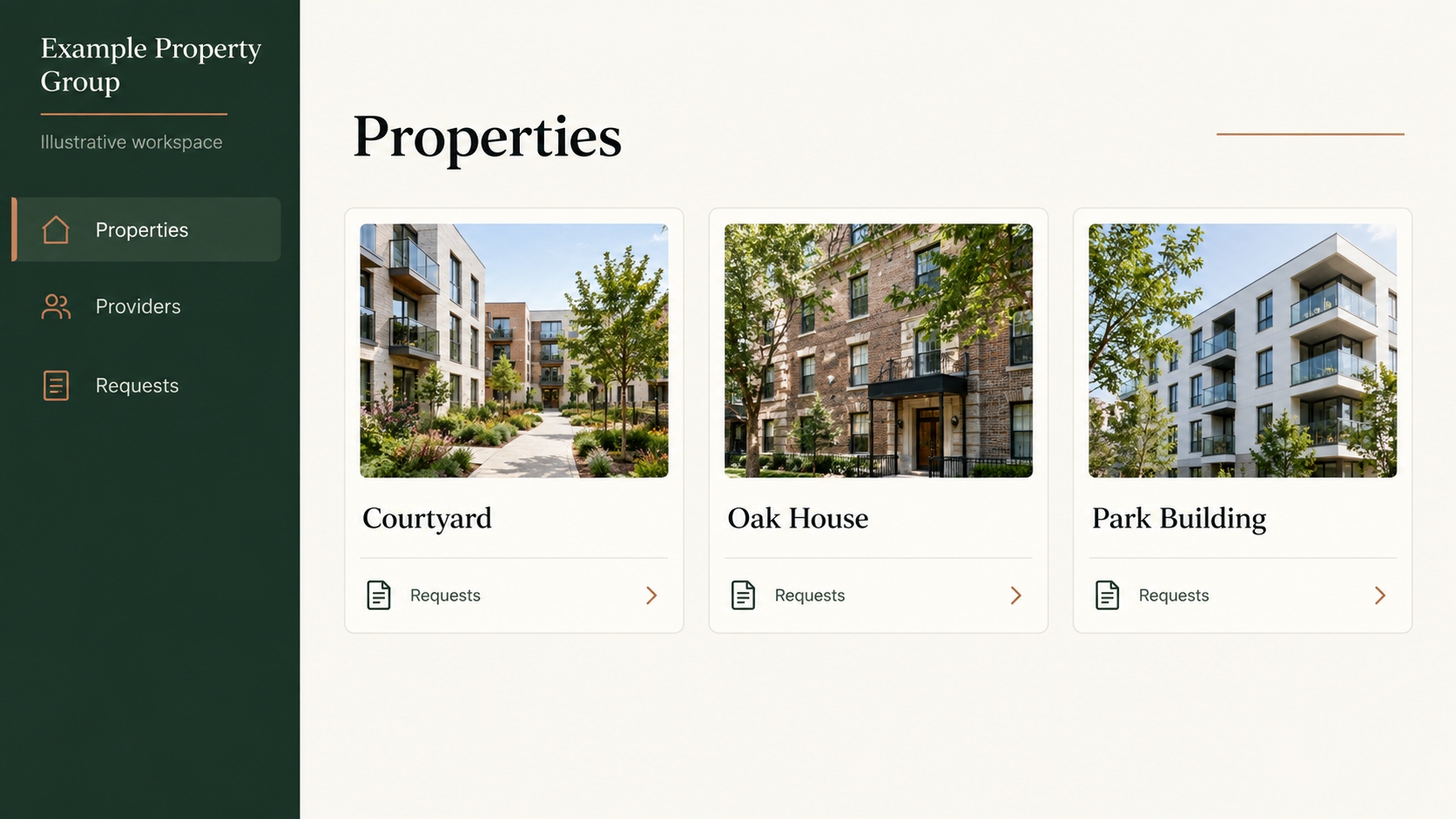
Each property-management customer has a separate workspace for its organization, users, services, approved businesses, phone assignment, routing configuration, and call outcomes. Another customer cannot view or alter those records.
Management visibility
The workspace separates a call from a connection, and a connection from a completed service outcome.
Control boundaries
This system is not a replacement for emergency services. Safety-sensitive situations require an approved response policy.
Example request
A tenant identifies the property and reports the HVAC issue. The system collects the approved minimum information and applies that property’s after-hours policy. The designated HVAC provider receives a brief summary and chooses whether to accept. If accepted, the connection is attempted and its actual result recorded. If not, an alternate is attempted only when explicitly configured and eligible; otherwise the approved message path is used. Management can review the result.
The system does not invent availability, promise dispatch, or select a contractor outside the approved configuration.
Fictional demonstration records
Two alternative outcomes for the same invented request, not real tenant data, a live test or a completed service result. Cedar Court and Provider A are fictional. The fields below follow the shared routing demonstration: request, eligible recipient, acceptance, actual connection and follow-up owner.
Neither illustration replaces emergency procedures or proves production performance. Safety-sensitive situations follow the approved response policy and appropriate emergency services.
For a different field-service context, inspect the illustrative HVAC dispatch record →. That example concerns a dispatcher’s assignment; it does not add dispatch or repair authority to this tenant-call workflow.
Where it fits
A strong fit may include independent property managers, residential and multifamily portfolios, commercial property operators, and organizations with recurring approved contractors or after-hours maintenance demand.
Recurring service calls, several approved providers, changing after-hours responsibility or repeated unclear handoffs can make a review useful. If a simple forwarding or message arrangement already gives the caller a clear next step and someone owns follow-up, that may be enough. Fit depends on the workflow, not an invented property-count or contract-value threshold.
Before launch
A review can be scoped to map one property or service category, its approved providers, hours and escalation ownership. The agreed output should identify current records, integration questions, unresolved decisions and the evidence needed before any activation decision.
Service categories, properties, hours, approved companies, phone assignment and connection settings must be configured and tested for your organization. Establish which existing property or maintenance records remain authoritative and verify any required integration; this is not a promise of compatibility with every system.
Preparation illustration only, not customer configuration or an instruction to activate. Names are invented. Unapproved schedules and missing availability remain unknown.
These are proposed acceptance conditions to agree for the scoped deployment, not a security certification, a production test report or a universal guarantee. Review comes before configuration; configuration and validation come before a separate activation decision.
Considering the service?
Bring one recent recurring handoff and the operating role responsible for it. Agree whether a property/service and responsibility map would help clarify provider eligibility, escalation, integration questions, validation gaps and the next decision.
Begin with a general description. Do not send tenant records, private access instructions or credentials in the initial inquiry. Scope, deliverables, access, responsibilities, timing, fees and any continuing support are agreed separately; an inquiry does not activate the service.
Existing Adaptiv Stratum customers
Use the email address authorized for your organization to request a one-time sign-in code. No password or Cloudflare account is required. This login is for existing customer access; it does not configure or activate the phone service.