

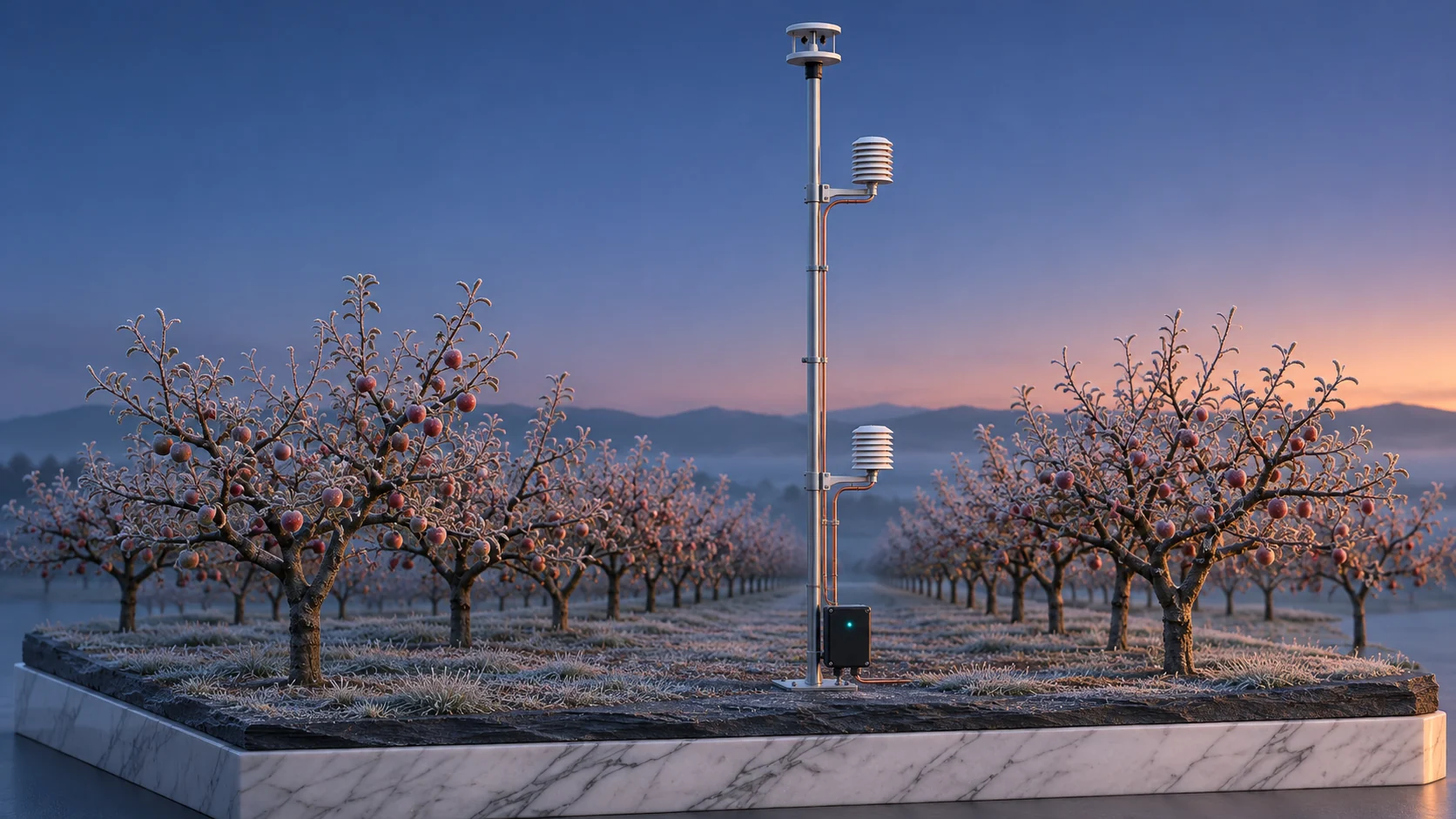
Before deciding whether an orchard wind machine could help, check whether there is warmer air above the crop to mix down. A weather tower with two matched temperature measurements can show that difference. Pair it with wind readings, crop-stage observations and the site’s approved frost plan. A cold canopy reading by itself cannot tell you which protection method is appropriate.
This guide is for orchard and vineyard operators, crop advisers, and irrigation or equipment teams. Start with an advisory installation in one representative block. Keep existing protection equipment and its trained operators in charge.
Distinguish a calm inversion from an incoming cold air mass
On a calm, clear night the ground and crop can lose heat by radiation. Air near the canopy may become colder than air above it. A wind machine can mix the layers when warmer air is present within reach, but the response depends on the height and strength of the inversion, terrain, wind and equipment. Windy cold-air movement, often called advective frost, can leave little useful inversion. Conditions can also change or combine during one event. See the FAO’s frost type discussion and active protection guidance.
Start with the crop rather than the forecast minimum. Record the variety, bud or flower stage, site history, and exposure duration. Critical temperatures change as buds develop. Air temperature measured in a shield does not always equal bud or leaf temperature. Use local crop guidance and trained observation to decide when the site plan applies. Penn State Extension’s stage-based tables show why a single freezing number does not cover all blocks.
Measure two heights together and verify the wind
- Air temperatures. Match two calibrated sensors, for example suitable resistance temperature detectors (RTDs), in comparable aspirated shields. One could be at 1.5 m and the other at 10 m in a layout the frost specialist approves. Those heights illustrate a reference profile. Actual placement depends on the canopy, tower, expected inversion and protection equipment. Use a representative unprotected reference, clear of the machine’s mixed-air plume, to estimate the inversion that was present before intervention. A low spot may need its own separate crop-height sensor. Campbell Scientific’s aspirated shield guidance describes how the shield reduces radiation effects on temperature measurement.
- Wind speed and direction. Use a sensor suitable for the expected cold, moisture and icing. An ultrasonic head can measure both quantities, but some models are unsuitable for rime or ice. For example, Campbell Scientific documents those limits for the WindSonic1. Log sensor health, gusts and direction with the two temperatures, and note when wind direction is unreliable in calm conditions. Compare exposed and sheltered parts of the site.
- Wet bulb, dew point and water delivery. Dew point is the temperature at which the air would reach saturation as it cools. Wet-bulb temperature describes cooling by evaporation under stated ventilation conditions and is a different quantity. Use a maintained aspirated wet/dry-bulb setup or a validated calculation using the relevant air measurements and pressure. Follow the instrument’s method for freezing conditions, when a wet wick can freeze and an ice-bulb treatment may apply. Confirm actual sprinkler pressure and flow separately. A tipping bucket can corroborate liquid precipitation at its position. It does not prove sprinkler delivery or crop coverage, and an unheated bucket may not register frozen precipitation properly. See the FAO’s frost micrometeorology guidance.
Before installation, place the matched temperature sensors together and compare them against a reference through the range of interest. Then check synchronized timestamps, response times, shield airflow and the reference instrument after mounting. Record calibration offsets and the field uncertainty of the difference between sensors. A failed aspiration fan or mismatched sample times can mimic a weak inversion.
Compare two cold nights with different evidence
Calculate inversion strength as upper air temperature minus lower air temperature for the same timestamp. Suppose your paired field checks established an illustrative uncertainty band of ±0.4 °C for that difference.
- Night A. At 03:10, the lower sensor reads −1.8 °C and the upper sensor +0.6 °C. The difference is +2.4 °C. Light winds and a persistent positive difference make this consistent with a radiation inversion at the tower. The grower checks crop stage, representative cold spots and the approved operating limits before deciding whether the wind machine is useful. A +2.4 °C inversion is not a promise of +2.4 °C warming at the buds.
- Night B. At the same time, the lower sensor reads −1.6 °C and the upper sensor −1.4 °C. The difference is +0.2 °C, within the example uncertainty band. Winds are sustained and the two temperatures continue to fall together. The station has no convincing evidence of warmer air aloft for the machine to use. Check the site’s plan for a windy cold event and verify any suspect sensor independently.
Plot both temperatures, their difference with an uncertainty band, and wind speed and direction. Add equipment-state and operator-action timestamps. An inversion can erode when the wind rises. Recheck it across the event rather than classifying the whole night from one point. These values illustrate interpretation and are not start thresholds.
Keep frost protection decisions within the approved plan
Overhead sprinkling has different constraints from wind mixing. Evaporation can initially cool wet plant surfaces, especially in dry or windy conditions. Where a trained irrigator and crop specialist approve water-based protection, the plan needs verified water supply, pressure, distribution, and continuity for the event, including what to do if pressure or power fails. Start and stop criteria depend on the crop, weather and system. The FAO’s active protection guide explains why water and wind combinations need care, especially when sprinklers wet the plants. Do not infer that one method can be combined with another from the temperature difference alone.
Use the experimental station for observations and alerts. A trained operator should make decisions through the installed, approved control system and independent protective functions. Do not connect the prototype to unattended starts for wind machines or sprinkler valves. Have a qualified site team design the tower and electrical installation, including structural loading, clearances and service access. Record which alarms prompt an inspection and who can authorize any response.
Prove the station before relying on a cold-night alarm
An ESP32-WROOM-32UE can serve as an edge logger with documented sensor interfaces and a supported antenna. RTDs need appropriate excitation and measurement electronics. For a contact-output tipping bucket, choose a suitable input and verify debounce and tip scaling. The standard PCNT peripheral does not keep counting through deep sleep. If the station sleeps, use a tested RTC-domain or external always-on counter. Espressif provides an original ESP32 ULP pulse-counting example. Confirm that the chosen sampling interval detects the real pulse widths and tip cadence. A missed pulse is a data gap, especially if the counter loses power.
- Test before and after mounting. Compare both sensors in the same shielded conditions, then verify the upper and lower readings against a reference. Test blocked aspiration, a frozen or unreadable wind head, timestamp drift and a disconnected probe. Suppress inversion conclusions when either required reading is stale or suspect.
- Budget the worst season. Include aspirator and wind-head loads, any approved heater, enclosure and radio losses, several cloudy days, low-temperature battery behavior, and transport or recovery overhead. Size the supply from measured load and verify local logging and alerts when communications fail.
- Walk through a cold-night decision. Review a calm inversion, a windy event and an instrument failure with the grower and trained equipment operator. Track when evidence arrived, how fast it was acknowledged and what reference checks confirmed. Assess any measured temperature response at several crop-height locations rather than using a single sheltered sensor to judge coverage.
A useful station gives the orchard team time to check a real condition and use its established protection plan. Compare a commercial frost station, a simpler pair of temperature loggers and a custom ESP32 logger on the same evidence and maintenance needs.