

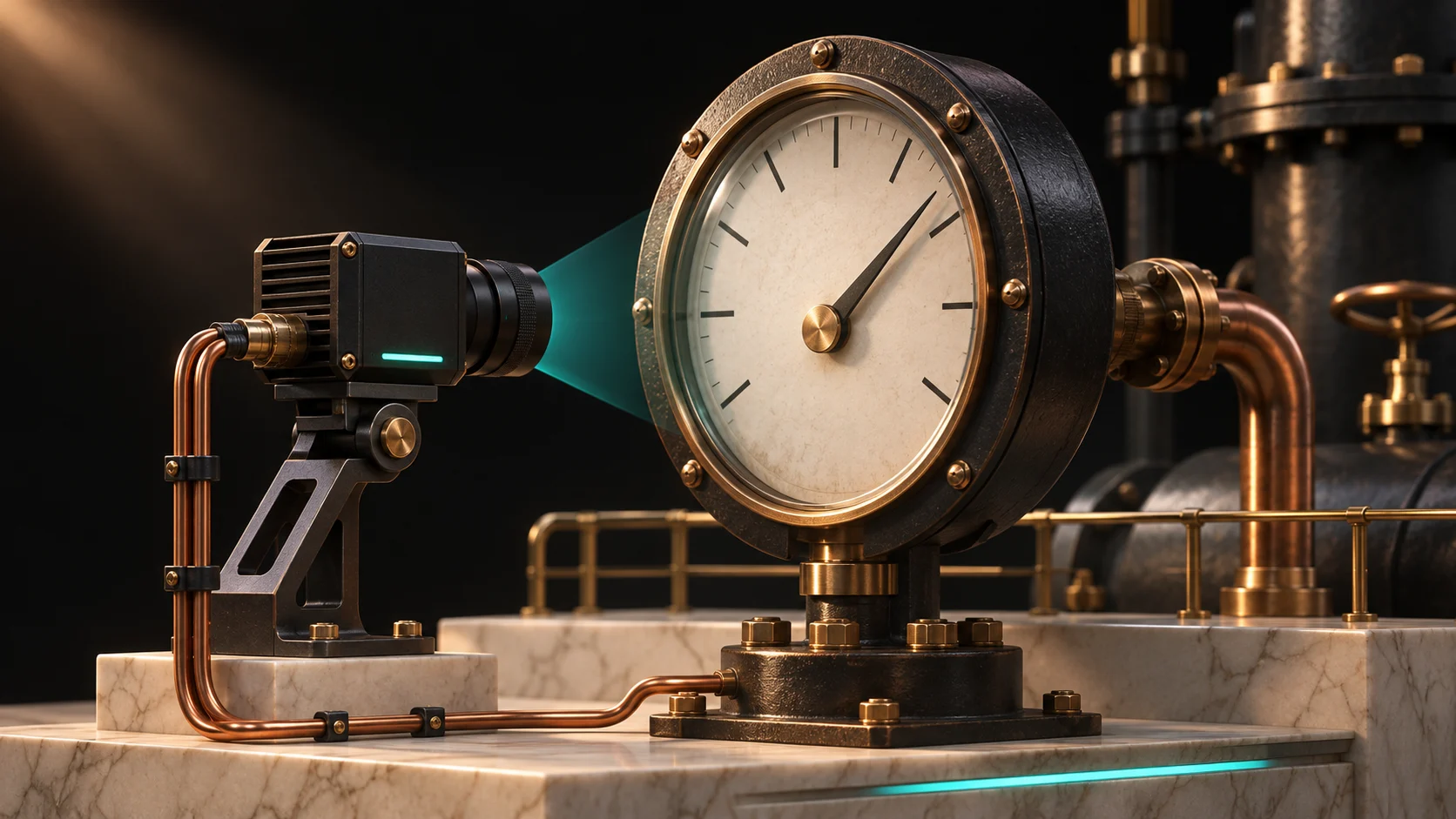
You can turn a dial into a useful history if the record is accurate enough for the decision and staff can see when a reading is unreliable. Decide first whether you need a rough trend, a scheduled reading for review, or a dependable measurement near a decision boundary. Those jobs may call for different equipment.
Choose the measurement path before choosing a camera
- Read an existing signal.
- Ask whether the same measurement is available from a supported controller point or instrument output. Confirm the scale, units, measurement location and update behavior. Do not assume that a similarly named point measures the same thing.
- Have a qualified installer assess a transmitter.
- If the process can accept a supported instrument change, a transmitter can provide a direct measurement. Some instruments combine a local dial with an electrical output; see this manufacturer’s example of a gauge with an output signal. Verify range, process compatibility, installation constraints and the continued availability of the local indication.
- Use a fixed camera to read the existing dial.
- Consider this when there is no supported signal and changing the instrument is impractical. Treat the output as an estimate of what the dial showed. A camera does not improve the calibration of the underlying instrument.
Prove the reading under ordinary conditions
Compare camera readings against human readings at the same time and across the part of the scale that matters. Define acceptable error with the person who will use the result, including the conditions under which an estimate is too ambiguous to record. Test reflections, low light, a partially blocked dial and a shifted camera. If the scale or needle cannot be read confidently, mark the observation unreadable and leave the numeric value blank. A last known reading must keep its original timestamp.
Illustrative example: one reading and one gap
A fictional facilities team wants to compare filter differential pressure between walkthroughs. The fixed camera estimates 0.8 inches of water column at 9:00 a.m.; the operator records the same reading from the dial. At noon, glare obscures part of the scale. The noon record says “unreadable: glare,” with no numeric value. The chart keeps the 9:00 reading at 9:00 and shows the gap. These are invented observations, not operating limits.
Keep enough context for someone else to review it
Store the gauge identity, timestamp, units, reading method and validity with each observation. Where appropriate and permitted, retain a dial crop long enough to review disputed readings. Retest after changes to the gauge, mounting or lighting. If you need a measurement for an alarm, safety function or operating decision the camera cannot support, use a measurement path qualified for that job. Leave existing controls and protective functions in charge.
See equipment monitoring for defining the decision, and embedded systems for equipment monitoring when the sensing or processing needs a custom design.