

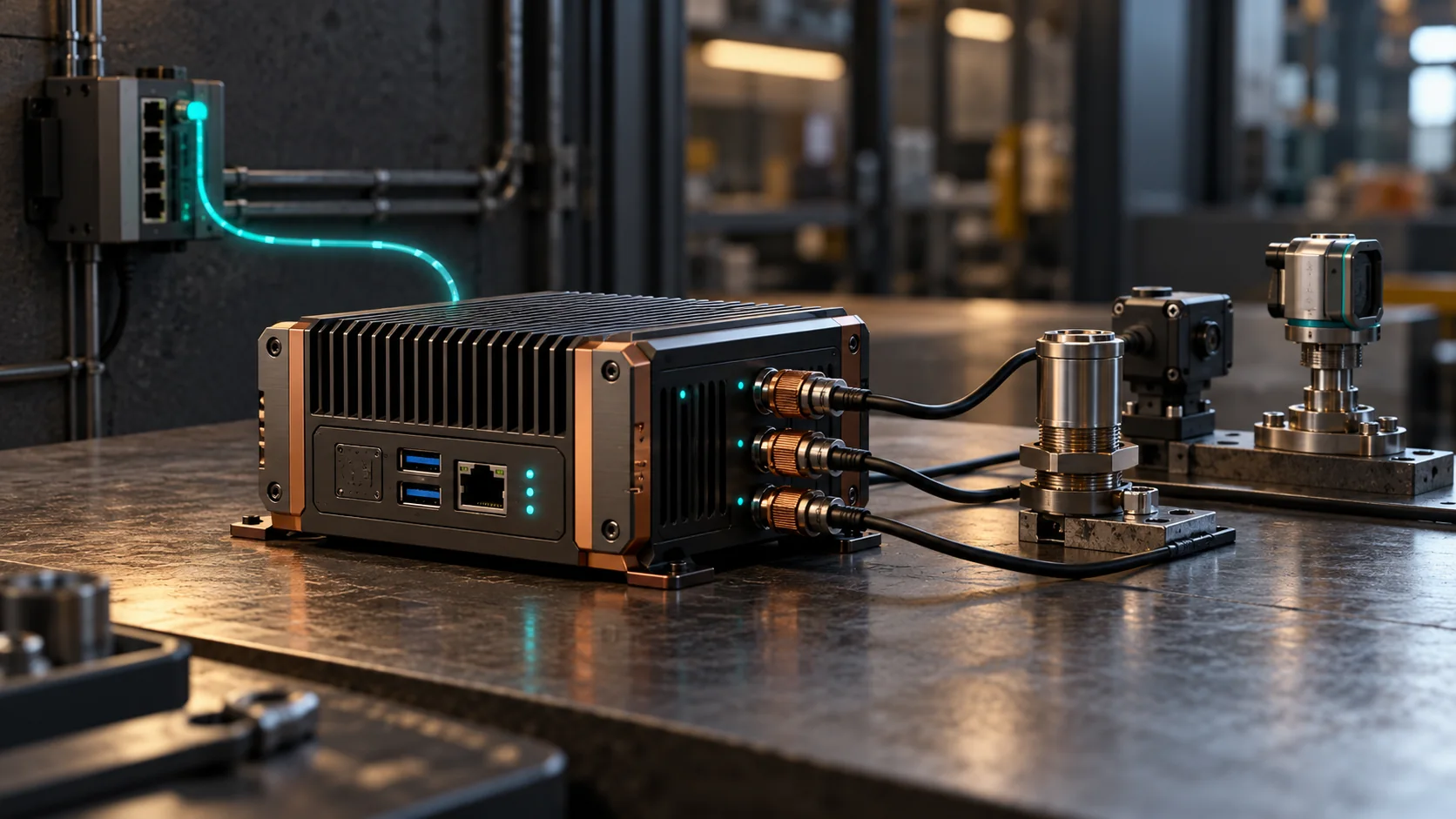
A field technician working with unreliable connectivity may need a compact assistant that can extract equipment details locally. A central analyst comparing complex documents may need a more capable hosted model. Neither situation is improved by treating model size or hosting location as a matter of ideology.
Small and edge AI are useful options when they match the job. The decision should turn on task quality, latency, connectivity, data handling, device constraints, and total operating effort.
Distinguish size from placement
A small language model has fewer parameters than a larger alternative, but that does not tell you how well it performs on your task. Edge deployment means computation happens on a device or near the point of use rather than exclusively in a remote service.
The two ideas often overlap but are not identical. A compact model can run in a cloud service. A local server can run a relatively large model if the hardware supports it. Describe the actual architecture rather than relying on the label.
Apple's technical report demonstrates a particular on-device model architecture. Google's LiteRT-LM documentation describes local execution on supported platforms. These establish feasibility in defined environments, not that local models will dominate every enterprise workload.
An illustrative inspection assistant
Imagine technicians inspecting industrial equipment in facilities with intermittent network access. They need to record the asset identifier, transcribe a short note, and check whether required inspection fields are complete.
A local model could assist with interpreting the note while conventional validation checks identifiers and required fields against an approved local record set. The application clearly marks the age of that record set and any information unavailable offline.
The technician remains responsible for inspection observations and follows qualified safety procedures. The assistant does not independently diagnose a hazard or authorize equipment operation. If the task exceeds the local model's tested capability, it records the unresolved question for later review rather than guessing.
When connectivity returns, synchronization uses the authoritative system's conflict rules. A local draft does not silently overwrite a newer record. The application must handle device loss, interrupted uploads, and duplicate submissions as ordinary operating conditions.

Privacy requires more than local inference
Running the model locally can avoid sending some prompts to a remote inference service. It does not establish that every component stays local. Model downloads, application telemetry, crash reports, connected search tools, backups, and synchronization may still transfer information.
Review the complete data flow and the actual settings. Encrypt stored records where appropriate, restrict device access, define retention, and plan revocation for lost or reassigned devices. A private device can still expose sensitive information if it is poorly managed.
Conversely, a hosted service may offer controls that are useful for a particular task. Compare evidence and agreements instead of assuming that cloud means uncontrolled or local means compliant.
Test the device, not only the model
Evaluate on representative hardware under realistic memory, battery, temperature, and connectivity conditions. A model that looks responsive on an engineer's workstation may be unsuitable for the phones or tablets staff carry.
Use the same task set for local, hosted, and conventional-software baselines. Include difficult inputs, missing context, and cases the system should refuse or defer. Assess accepted outputs, response time, review effort, and recovery behavior.
The cheapest acceptable solution might be a structured form with validation rather than a language model. It might also be a hybrid arrangement in which routine extraction runs locally and complex analysis is escalated through an approved connection.
For the inspection pilot, test a realistic end-of-shift device rather than a freshly charged demonstration unit. Include a stale local record set, an interrupted synchronization, and a technician correcting an identifier after saving a draft. These cases reveal whether the application can preserve useful work under its actual operating constraints. A model benchmark alone will not answer that question.
Count the full lifecycle cost
Device acquisition, replacement, distribution, model updates, security patches, local storage, support, and quality testing belong in the comparison. Remote inference charges may be visible on one invoice while local operating costs are spread across several budgets.
Updates deserve particular attention. A new model version can change behavior even when the interface looks identical. Maintain a tested version, a rollback path, and a way to identify which version produced a record.
For some workloads, local execution will be the right balance of responsiveness, connectivity resilience, and data control. For others, the quality or maintenance tradeoff will favor a hosted service. The useful strategy is to choose the smallest adequate system for the specific need and remain willing to change that choice when the evidence changes.
Sources & further reading
Primary references checked October 18, 2026. Examples are illustrative, not reported client outcomes.
- Apple: Foundation Language Models Technical Report 2025Vendor-authored research demonstrating an on-device architecture; not a universal cost or quality comparison.
- Google AI Edge: LiteRT-LM overviewOfficial documentation for supported local inference capabilities and platform dependencies.