

AI ADVISORY ARCHITECTURE
Why use an AI advisor?
Different forms of work have different strengths. Machine systems can retrieve, compare, calculate, monitor, and rerun structured analysis at scale; people provide context, judgment, accountability, and authority.
The fundamental difference
AI advisors are not replacements for human advisors. They are software roles with defined scope, approved context, and review boundaries. People remain responsible for objectives, consequences, negotiation, ethics, and decisions.
Machine strengths
Retrieval
Repeated calculations
Parallel checks
Consistent procedures
Versioned instructions
Rapid re-analysis
Human strengths
Contextual judgment
Accountability
Tacit knowledge
Stakeholder alignment
Physical-world observation
Professional authority
What the evidence shows
Evidence is task-specific, not a universal ranking. In a field study of 5,179 customer-support agents, access to a generative assistant increased productivity by about 14% on average, with larger gains for less-experienced workers and little benefit for the most experienced. A separate controlled writing experiment found that generative assistance changed productivity and reduced performance inequality for the tested writing tasks. These findings describe AI-assisted work in specific settings; not autonomous AI performance or every advisory engagement.
Brynjolfsson, Li & Raymond, “Generative AI at Work,” NBER Working Paper 31161 (2023) · Shakked Noy and Whitney Zhang, “Experimental evidence on the productivity effects of generative artificial intelligence,” Science (2023)
Parallel review and repeatability
One question can be routed to bounded specialists: evidence, security, finance, architecture, operations; and then synthesized. The benefit is structured independent challenge, not a guarantee of correctness.
ONE QUESTION
  ├─ Evidence review
  ├─ Security review
  ├─ Financial review
  ├─ Architecture review
  └─ Operations review
          ↓
      SYNTHESIS → HUMAN DECISION
A controlled process applies the same definitions, checklists, and evidence rules repeatedly. Consistency still requires validation: a consistently wrong method remains wrong.

Information scale, memory, and reruns
Structured systems can retrieve relevant material from approved procedures, databases, APIs, policies, technical documentation, research, and historical records. They preserve versioned decisions and assumptions so a changed price, staffing level, capacity figure, or regulation can trigger a documented re-analysis.
Where humans remain necessary
Accountability, approval, negotiation, leadership judgment, ethics, ambiguous objectives, high-consequence decisions, physical inspection, professional licensing, and exceptions outside system boundaries remain human responsibilities. Availability and speed do not create authority.
The hybrid model

This is the operating model behind the directory: capability and permission stay separate, sources and assumptions remain visible, and consequential actions require accountable review.
When an AI advisor is useful
AI advisors are most useful when the work involves high-volume research, comparison, repeated analysis, monitoring, or preparing a decision for review. They can make the first pass faster and make assumptions easier to inspect.
- Compare vendors, designs, or operating options against explicit criteria.
- Rerun a known analysis when prices, capacity, staffing, or regulations change.
- Monitor approved signals and surface exceptions for a responsible owner.
When not to use one
An AI advisor should not be used when the objective is undefined, source data is unreliable, or the decision requires licensed professional judgment, physical inspection, negotiation, or direct human care. High-consequence decisions need a named human reviewer even when analysis is automated.
What a recommendation contains
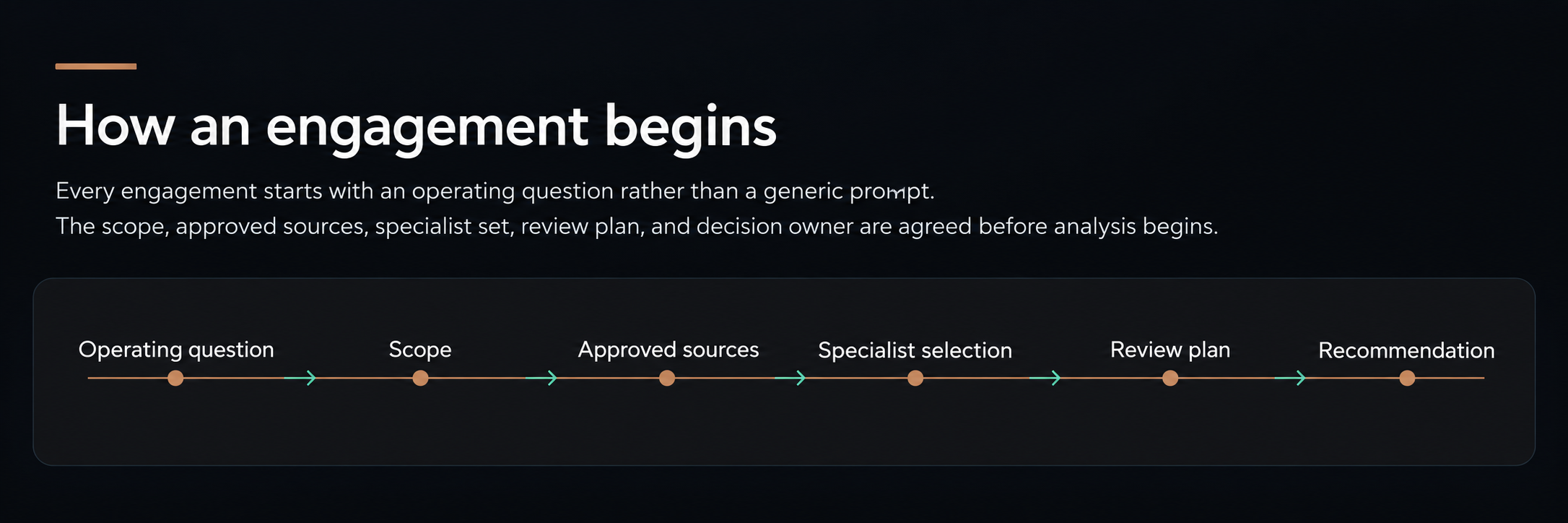
A reviewable recommendation identifies the question, sources, assumptions, uncertainty, alternatives considered, recommended next step, and approval required. This makes it possible for another person to challenge the reasoning instead of trusting a polished answer.
Failure modes and safeguards
Useful systems make failure visible. Hallucinations require source checking; stale information requires dates and versions; missing context requires explicit assumptions; bias requires counterexamples and independent challenge; unauthorized actions require permission boundaries.

A concrete example: predictive maintenance
For a predictive-maintenance question, one advisor reviews telemetry, another examines failure modes and maintenance history, and a review role checks evidence quality. The resulting recommendation can prioritize an inspection or model a maintenance interval, but a responsible engineer still decides whether to authorize the work.
How success is measured
Success is measured by more than speed. Useful measures include accuracy, time saved, repeatability, exception detection, review quality, decision traceability, and whether the recommendation improved the actual operating result.
What human authority means
Human authority means setting objectives, accepting risk, approving action, communicating the decision, and remaining accountable for consequences. A system can recommend a path; it cannot inherit responsibility for taking it.

Research & sources
- NIST, AI Risk Management Framework 1.0 (2023) ; governance and risk-management framework.
- International Labour Organization, Generative AI and Jobs (2023) ; augmentation is more common than full occupational automation.
- NBER Digest, Measuring the Productivity Impact of Generative AI (2023) ; summary of the 5,000-agent field study.
- NBER Working Paper 31161 (2023) ; methods and limitations for customer support.
- Science, Experimental evidence on productivity effects (2023) ; controlled writing-task evidence.
- Microsoft Research, early AI and productivity report (2023) ; vendor-sponsored, task-specific evidence.
- OECD AI policy and measurement resources ; measurement and policy context.
- NIST AI RMF Playbook ; operational governance guidance.
- ISO/IEC 42001 ; AI management-system standard.
- UK Government AI regulation white paper ; regulatory and accountability context.